
Wednesday, September 7, 2011

Betting progressively with a wide spread doesn't mean greater risk. More often than not, it's safer than staying at a low-limit table.


_
It's fair to say that no one sample of outcomes, especially one as small as 5,000 rounds, is proof of the Big Picture.

But the "you can't win" mythematicians are adamant that negative expectation cannot be beaten, and equally insistent that raising bet values is the worst possible way to get out of trouble.

They lie.

Small as the Bodog blackjack sample may be in relation to the millions of bets that are placed in casinos worldwide every day, patterns emerge that are relevant to the challenge of winning consistently.

After all, when you - yes, I mean You! - take out your wallet in a casino, you'll make at most 200 bets an hour, and not more than 1,000 before you call it a day.

And the house will expect to have you opening your wallet again and again long before you reach bet #1,000.

The idea that bigger bets mean bigger risks and therefore bigger losses is yet another of the myths of disinformation that casinos foster in order to discourage the idea that their games can be beaten in the long run.

Taken at face value, it's true that more money at stake means more money lost, but only for gamblers who follow the herd and bet tight spreads.

A player who bets $1,000 to $5,000 a hand is, obviously, just as likely to lose as one who bets $5 to $25 - he'll just have more to complain about.

Widen your wagering spread from the smallest permissible bet (usually $5) to the largest available table limit (well above $25,000 on the Las Vegas Strip) and you will beat negative odds every time.

It can't be done with a picayune bankroll, obviously - but life as a grown-up will have taught you by now that making money without money to start with is a very tough proposition indeed.

When I played through all those tedious Bodog blackjack sessions, I started each new series with a $1 bet and used the rules already published here to bet all the way up to the skimpy table max of $500 whenever necessary.

The Bodog practice games permit a $1,000 virtual buy-in, and whenever I busted out, I clicked up another grand and resumed betting at whatever level was appropriate.

The result of each hand (win, lose, push, double, split, natural and so on) was faithfully recorded, bet values and all, and at the end of every session, I keyed the data into a spreadsheet.

A grid of conditional formulas then "replayed" the Bodog results with real-world bets according to a rules set that can be varied at will (hence my ability to tell you what the final 5,000-round outcome "woulda" been if I had played things differently).

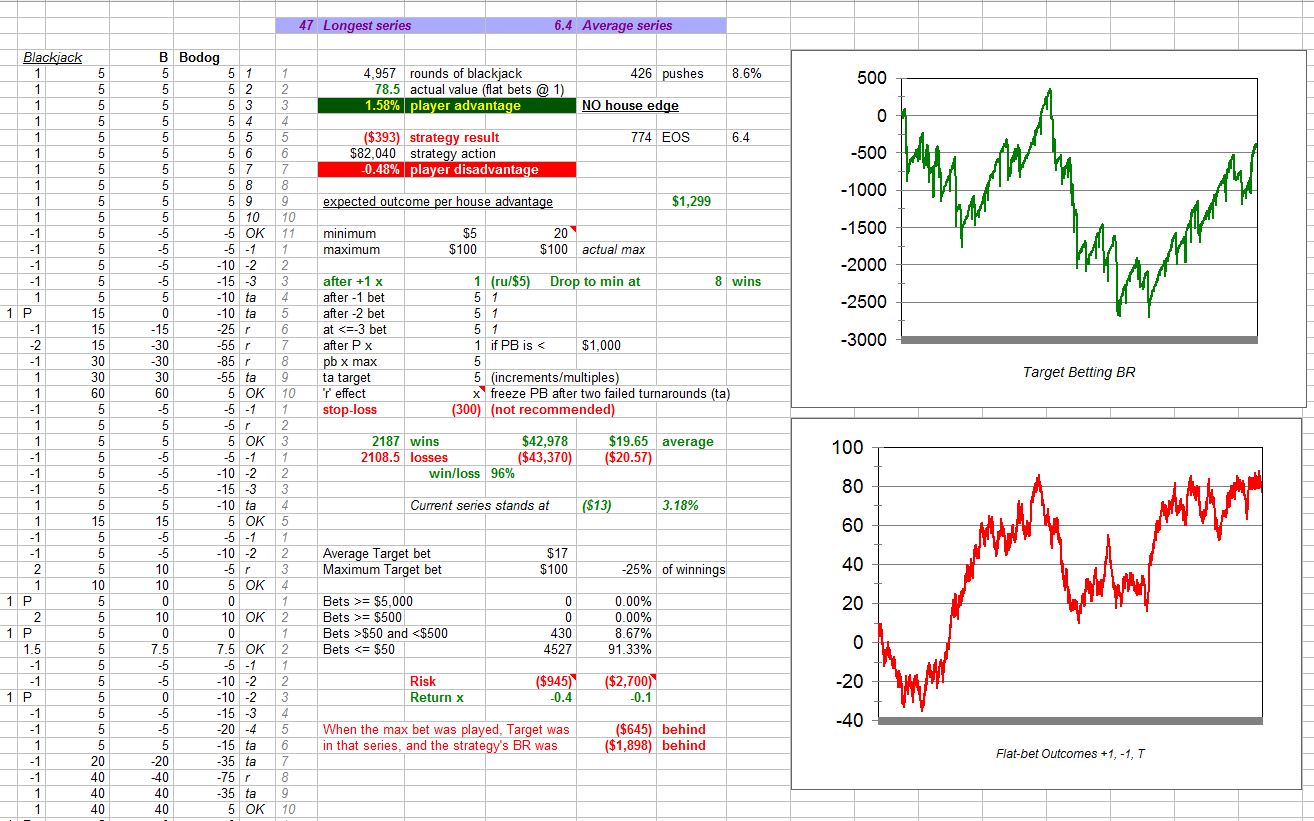
The summary above confirms what I have been saying for years: A tight spread will kill ya.

It's no surprise at all to me that in all but seven out of 23 sessions, betting Bodog's table limit resulted in MORE money at risk, not less, and a final outcome that was negative in spite of the fact that I won more hands than I lost.

That's exactly how it goes in the real world - although there's not a casino anywhere that will permit blackjack hands to be recorded in a log, so you'll have to take my word for that!

The good news is that the results shown above are supported by simple logic.

Whatever your maximum bet limit may be (the most the casino will allow, or the most you feel you can afford), the sooner you reach it, the more certain it is that your goose will be cooked.

Progressive betting of any stripe requires wiggle room. And when you can't recover your losses in fewer bets than it took you to get into trouble, your chances of getting ahead again are virtually nil.

The flipside is the narrower the spread between a casino's min and max, the more likely it is that any player will end up a loser.

Bodog's 1-500 spread is, in fairness to the crooks who run the game, vastly wider than most people would even think about adopting for their own play.

Too risky, they'd assume. And, of course, they would be wrong.

At the end of the day, Target's real-world (by which I mean Nevada-style) betting levels resulted in more than a 12% hold of all action - action that was 10% less overall than Bodog's low table limit required.

There's nothing wrong with my math.

I take great pride in knowing my numbers and checking them a whole lot more often than twice.

No one should sign on for any gambling proposition without a full understanding of the mathematics involved.

Casinos know all about the power of progressive betting, which is why they go to such lengths to obstruct its use.

And the sad thing is that the disinformation they put out to bolster such measures as tight table limits and shuffle delays are widely believed.

After all, casinos wouldn't offer games if they could be beaten in the long run, right?

Wrong!

Casinos need winners almost as much as they need losers, because winners provide losers with hope and inspiration.

If table games were truly unbeatable, winners would be like hurricanes in Hertfordshire - they'd hardly happen.

It's just sound business for casinos to do whatever is necessary to make sure that winners comprise as small a minority as possible.

And as far as they are concerned, a consistent winner is their enemy.

Come back soon and I'll post comparative results from my Bodog baccarat sessions. I can promise you ahead of time that they will tell the same story.

UPDATE at 2:00pm:-


Same story...some of the time.

The big difference between the Bodog baccarat simulation and the blackjack game is that the baccarat spread is just 1-250, so overall, Target's Nevada limits ($25,000 vs. $250) resulted in action that was 43% greater overall.

Given a table limit that was 10,000% higher than Bodog's, the "experts" would have you expect a far more dramatic difference!

As it is, Target delivered an 8.0% "hold" of its slightly higher action (a win of more than $23,000) vs. the -3.0% $6,200 LOSS that was caused by the tight spread imposed by Bodog.

And five times in 15 sessions, a $250 cap resulted in more money in play as well as more money lost compared to a table limit 100x greater.

QED, as those ancient Romans used to say...

A few more words about baccarat, Bodog-style: I just checked my logs and discovered that at no time did I bet more than $200. I can't guess why - the screen shots confirm the actual table limit was indeed $250. I bet $200 718 times for a total loss on max bets of $4,000. If I had bet the maximum, the overall action for the 15 baccarat sessions would have been increased by $35,9000 to $237,902 - making the difference between Target's "Nevada" action and its Bodog action 21%, not 43%. That's what I get for checking things thrice - and I thought you'd all want to know.

An important reminder: The only person likely to make money out of this blog is you, Dear Reader. There's nothing to buy, ever, and your soul is safe (from me, at least). Test my ideas and use them or don't. It's up to you. One more piece of friendly advice: If you are inclined to use target betting with real money against online "casinos" such as Bodog, spend a few minutes and save a lot of money by reading this._

Tuesday, September 6, 2011

The game you choose to play makes a difference, but how you play it does not. All that matters in the long run is how you bet.

_
(Target's sports betting experiment continues to prosper! For current information, please go to the Sethbets website)

I just wrapped up my final Bodog freebie blackjack session, and it ended pretty well.


But of course as always, the result you see here doesn't prove a thing.

All it does is suggest that even against a house-imposed spread as narrow as 1 to 500, it's possible to win once in a while.

Or it would be if we didn't already know that Bodog uses its "practice" table game simulations to reel in real-cash customers with softball numbers that can only be seen in the virtual world.

Then, when there's cold, hard cash at stake, the game switches from a pushover player advantage (+1.58% in almost 5,000 rounds for me) to a crooked game more punishing than anything you would find in a regulated bricks-and-mortar casino.

The screen shot above is, I want you all to know, misleading: I busted out three times before Target finally got the upper hand, so the final "win" is actually $4,000 less than it seems to be.

As it happens, this last Bodog battle was not as player-friendly as some have been.

There was a house edge of 0.74%, meaning that according to Eliot Jacobson, Ph.D. and other gambling "experts" I should have lost $305 of my total action of $41,000 in this farewell 269-round session.

As you can see from the Bodog screen shot above, in this case something went wrong with the experts' prediction.

And overall, the experts were just as badly off the mark.


What matters most is that the set of Target rules that thrashed Bodog's funny-munny blackjack game did the same against the online "casino"'s baccarat simulation.


It is, to use a word that gambling's mythematicians adore, axiomatic that while it is possible to devise a betting strategy which will beat one data sample, the same method is certain to fail against any other sample of similar or greater size.

I am much more concerned with the fact that when all of Target's bells and whistles are stripped away and only the critical "LTD-plus" response to a mid-recovery win is applied, negative expectation remains a harmless irrelevance.

It doesn't take fancy footwork to defeat the dreaded house advantage - just good old mathematics.

But I am, I admit, very fond of my bells and whistles.

They exist to help camouflage the fact that from time to time, very large increases in bet values are required, making the strategy's next bet (NB) up to 10 times the value of the previous bet (PB) in response to a qualifying win.

Dealers notice little details like that, and dutifully report them to the pit staff behind them when they take their breaks from the exhausting business of emptying customers' wallets.

So I prefer to bump bets after any win, and to confuse everyone but (hopefully) myself by doing the same after some losses.

Target needs two consecutive mid-recovery wins to achieve turnaround, which is an elegant way of describing the very satisfying recovery of all prior losses plus a modest overall profit.

Because of that, it faces roughly twice the challenge of a Martingale, which achieves turnaround with a single win after one or more losses, but can at times demand some even scarier bets than Target.

Against the Bodog blackjack sessions, for example, a Martingale player would have "won" $54,000 in virtual chips after risking $46,000 - whereas I "won" $115,000 after at one point sliding almost $90,000 into a nasty hole.

The good news is that before double-up got into its worst case scenario, it was more than $50,000 ahead. And at its low spot, Target had begun its nightmare slump with $45,000 in winnings. That counts for something!

Most of the people who read this blog are looking for a nice-'n-easy way of making big money with little or no risk, so I have to keep saying that in my long experience, such a thing is not possible.

Even casino operators and bookmakers have to accept risk is part of the cost of doing business, and so it is for gamblers who expect to be consistent long-term winners.

Billy Walters, my role model among professional gamblers, says he's often had losing days, weeks and even months - but never a losing year.

Some days, Walters has $1,000,000 or more in play, spread out among dozens of Las Vegas sports books with the help of a network of "associates" who are very well paid for fronting his bets.

He knows that it takes money to make money, that you can't win without losing, and any number of similar Las Vegas cliches.

Billy Walters uses a complex computer handicapping algorithm to pick his sports bets, and given his year-to-year success, it's clear that he knows what he's doing.

When it comes to sports betting, I barely know a baseball stick from a hockey bat, so I prefer to make my "picks" randomly (I put quotes around the word because the truth is, my selections choose me!).

And that takes me to the point of the headline at the top of this post.

However brilliant you might think you are at blackjack or whatever other game in which you choose to invest, the only thing that can make a difference in the long run is how you select your bet values.

One of the regulars at my local casino is a dapper, serious fellow who rarely plays blackjack anywhere else and is perfectly happy with the house's $300 table limit.

He plays every day but never for more than two hours at a stretch, he sticks devoutly to basic blackjack strategy (except for a couple of personal quirks) and if he loses $300, he goes home, reverting to a minimum $5 on his first hand next day.

He insists that he never loses more than $2,000 a year, and because we're both polite gentlemen, I naturally believe him.

However, if that $300 loss limit, along with his $100 max per bet, were to be applied to the Bodog blackjack sample, the result would look a lot like this:


Not too terrible, you might think - except that this ultra-conservative method failed to make long-term headway even against a sample of outcomes with an overall player advantage above 1.5%!

It is a mathematical fact that the narrower (or tighter) your betting spread, the more likely you are to lose in the long run.

In spite of its occasional very high bets, a Martingale - especially with the win progression enhancement I use in my models - is by far the most effective method of progressive betting, given that it only needs one win to recover all prior losses.

That makes it the most effective winning method there is, period, because in the long run, only progressive betting (aka money management) can consistently beat a game with a negative expectation.

I devised Target almost 30 years ago because I could see that a Martingale simply wasn't playable.

Casinos find all sorts of ways to shut out a double-up bettor, beginning with mild harassment and leading eventually to an outright ban.

The Martingale result against the Bodog blackjack sessions is impressive, and confirms that it does not have to be fatal even when you hit a table limit.

Mr. Expert, Ph.D., will tell you that the cards have no memory, yadayada, but the fact is that after you have been badly but not fatally wounded by a prolonged losing streak, you are likely (but not certain) to benefit from what Wall Street statisticians like to call a correction.

What matters is that you have enough money behind you to take you through a rough patch - witness the forty grand plus that my double-up player had to pull out of his virtual back pocket before the numbers settled back towards the norm and he was able to recover his losses.

For the record, when double-up hit its lowest point against the Bodog blackjack outcomes ($23,035 in the hole with a $23,040 bet on the table), it had seen TWELVE consecutive losses for a notional house edge of 100%.

At that point, while the odds of the next bet winning were on the one hand the same as at any other time (about 49.5:50.5 against), a 13th consecutive loss was theoretically just a little less likely.

Didn't happen, and Mr. Martingale made his money back plus a fat five bucks.

After 15 bets, the house edge for the series exceeded 53%. The next 15 bets swung the other way, giving a player edge of 3% and a 30-round house edge of 25%. After another 30 bets, the house edge since the beginning of the slump was down to 15%.

And so it goes.

I play strictly by the book in my models, making for bet values that would never apply in real play.

That $23,040 Martingale bet would have been $25,000 in the real world, for instance, with sensible rounding up also making Target's bets "tidier" to eliminate fiddling and fumbling.

There is, after all, no time for uncertainty when big money is at stake!

At blackjack, a religious adherence to basic strategy is always the best play, not just because losses will be minimized, but because it focuses all decision-making on bet values.

And, of course, Target further eliminates the need to think. Once you have the rules down pat, whichever version you choose to suit your style and your bankroll, you simply follow them.

Blackjack is, of course, the only table game that offers choices other than how much to bet and when.

I don't count pai-gow poker because its 5% house edge makes it a fool's game.

Baccarat offers the Player or Banker option, it's true, but I have always vetoed Banker bets because of the "5 percent" commission on wins.

Only a fool believes that the commission is truly 5%. Because it is not applied when a bet on the Bank loses, it can reduce your overall win (or increase your final loss!) by a percentage that is almost infinitely variable, often wiping out your profits entirely and leaving you with a commission tab outstanding.

Yes, it's frustrating when Player loses hand after hand - but it is always better than the alternative.

In the Bodog baccarat sessions, for example, Target earned a total of $141,000 in winning bets for a final profit of just over $23,000.

If half of those wins had been Banker bets (a reasonable statistical assumption), commission would have reduced the overall win by roughly $3,500, or 15.15%.

Five percent? Not even close!

I always advise students of Target to stick with blackjack whenever possible, or baccarat if they absolutely insist.

Both those games have a house advantage of less than 1.5%, which makes each round as close to an even money proposition as can be found in a casino.

I enjoy occasionally opening a new series with field bets at craps or even money (outside) bets at roulette, in spite of a house edge that can exceed 5.0%.

But when the going gets tough, I always retreat to blackjack or baccarat, simply because in the long run, they are a player's safest havens.

If you decide to try roulette, I recommend staying away from all but even-money bets (black/red, odd/even, first/last) and using the French avant derniere method to select your bets.

That means that if the spin before last came up Red, Red's your next bet, and so on (I call the method The Wobble, meaning win before last = WBL!). It means you catch streaks either way, and it can be a lot of fun.

But of course, fun is not really what we're about, is it? We're in it to win it.

Meanwhile, the casinos' very effective brainwashing machine insists that there's no way to win in the long run - but not to worry, because losing is FUN FUN FUN!

And pigs have wings...

If you take gambling seriously, treating it as something other than an expensive pastime, you will accept the fact that over time you are sure to lose more bets than you win, and think of losing not as "fun" but as a means to an end.

Regular readers will know that the Target mantra has always been that you have to win more when you win than you lose when you lose, so that losing more often than you win won't cost you money.

Only progressive betting makes it possible to achieve an average winning bet value (AWB) that exceeds your average losing bet value (ALB) by a percentage greater than the negative product of [losses minus wins divided by total number of bets].

In the Bodog baccarat sessions, for example, I LOST 1,139 bets totaling $117,620 and WON 1,104 bets worth a total of $140,865.

The house advantage (HA) for that data set was -35/2,243 indicating an actual value (AV) of -1.56% which softened to -1.41% when ties (or pushes) were factored in.

According to the experts, I should have lost $4,080 to comply with the "rule" that the end result of betting should come close to AV (or NE for negative expectation) x action (the sum total of all bets).

Because the experts are wrong - and know it - I actually WON $23,245 or +8.06% of action of $288,425.

That was possible because my ALB was $103 and my AWB was $128.

So when I won, I won 24% more than I lost when I lost.

Result: Happiness.

In the Bodog blackjack sessions, my overall ALB was $192 and my AWB was $238.

Again, I won 24% more when I won than I lost when I lost (24% is about right, but of course I'm happier when I can do better than that).

Similar or better results can be achieved with blind luck.

But luck, as we all know, never lasts.

Target does.

An important reminder: The only person likely to make money out of this blog is you, Dear Reader. There's nothing to buy, ever, and your soul is safe (from me, at least). Test my ideas and use them or don't. It's up to you. One more piece of friendly advice: If you are inclined to use target betting with real money against online "casinos" such as Bodog, spend a few minutes and save a lot of money by reading this._

Monday, September 5, 2011

They say casinos don't need to cheat with all the odds in their favor. They do it anyway just because they can. And to feed their greed...?

_
(Target's sports betting experiment continues to prosper! For current information, please go to the Sethbets website)

I have been accused of being naive because I think it's wrong that online casinos can manipulate the results of virtual table games - and wrong that they let funny-munny players win so they can take them to the cleaners once they start to bet "for real."

I'm also, apparently, naive to think that casinos have any interest whatsoever in the way people bet, the argument being that how (and how much) you bet can have no long-term impact on the house advantage.

Worse, I'm told I am deluded to believe that Martingale punters are at work in casinos every day, betting just two or three times at any one layout and hopping from one game to the next in search of the single win they need to land a big score.

Never mind that I have been a regular player in Nevada for more than 30 years, and have lived in the Silver State for 25 of those years...I am, I am assured by some of my readers, an innumerate idiot.

It gets better: Experts tell me that table and house limits are logistical constructs that have nothing whatever to do with controlling the way gamblers bet (they exist because small fry don't like to play with big fish, and vice versa).

I have to admit that even to me, playing thousands of rounds against Bodog's no-money versions of baccarat and blackjack seems an insane waste of time, especially since casinos with real games that are regulated and presumably trustworthy are less than 20 minutes from my front door.

But there is, I promise you, method in my madness.

I decided to press on with the Bodog tests to demonstrate that once the "casino"'s crappy limits were replaced with real-world bet spreads, Target would prove a winner.

So I endured Bodog's 1-200 baccarat restriction, and the 1-500 spread for blackjack, fully expecting to lose as I dutifully wrote down the result of every round.

You have seen the final baccarat numbers already: a limit-induced loss that was more than double the -1.41% expectation for the sessions replaced with a 7.6% overall WIN when Target was able to bet within reasonable limits that are available in casinos all over the world.

The blackjack sessions are on-going because I figured I might as well gather 5,000 outcomes and see if Bodog's "practice" game actually reflected real-play negative expectation by the time I reached that point.

Right now, it seems clear that Bodog's freebie game is meant to be a pushover, so that players who truly are as naive as I am sometimes accused of being will assume that the real game is just as beatable and open an account.

No such luck.

Right now, after 4,700 rounds, I have won 1.7% more bets than I have lost.

That's so dramatically adrift of statistical expectation that it's safe to assume something fishy's going on.

Bodog will probably suggest that I can't track results accurately, and their shills (Eliot Jacobson, Ph.D., and his buddy the Wizard of Odds among them) will say the data sample is too small to mean anything.

But I challenge those worthy gentleman to play that many hands of blackjack in a "real" casino and come out with substantially more winning bets than losing ones.

The great irony is that because of the Bodog table limits - and because I have been betting with a pretty aggressive set of Target rules - I'm still down -0.75% of my total action in spite of a 1.7% "player edge."

And that's no surprise at all. Table limits are intended to make losers out of everybody, including the lucky stiffs who somehow evade the house advantage and win more bets than they lose.

Blow those Bodog blackjack bet limits away, and Target delivers a "player's edge" of almost 14.0%.

Yes, it took money to make money. But that's always how it is when the house has the edge - or when it gooses its chances by imposing tight table limits.

The "no limits" Target win to date looks like this:


What matters more is how things "woulda" turned out if all of Target's fancy bells and whistles - rules variations that increase profits but are primarily intended to camouflage the strategy - were to be turned off.

Here's the answer:


Risk plummets - and so do profits.

But the core principle of Target - responding aggressively to a mid-recovery win - is mathematically vindicated.

Target permits a bet to be as high as 10x the win that preceded it, a jump that in my long experience causes dealers and the pit staff behind them to become very interested in a dramatic departure from "normal" player behavior.

Remember, most players impose a very tight betting range on themselves - 1 to 5 is about average - because they wrongly believe they are limiting their losses.

Apply even a 1 to 50 range limit on the Bodog blackjack outcomes, and you end up with a story that looks like this:


A win, yes - but one that could only have occurred with a very unlikely 1.72% "player's advantage" that Bodog certainly would not permit once anyone was betting with cold, hard cash!

And look what the spread limit does to the process: Instead of maxing out at 30 or so bets, it takes almost 2,000 rounds to recover in one instance, and the average recovery time sky-rockets from 5 or 6 bets to almost 400.

That's not a workable strategy: It's likely to end in a one-way ride to the funny farm!

I won't be playing any more baccarat rounds against Bodog: I can get all the written records I can use while playing for real money in my neighborhood, but if I produce pencil and paper at a blackjack table, all manner of alarms go off!

Casinos are not mindlessly paranoid about their thin margin at blackjack (less than +1.0% against a disciplined player).

They know full well that progressive betting will consistently bite big chunks out of their bottom line when it's done right and they will do whatever it takes to prevent its use.

That includes cheating.

Here are the final baccarat reports:


The moral of this story: Never play without a plan!

An important reminder: The only person likely to make money out of this blog is you, Dear Reader. There's nothing to buy, ever, and your soul is safe (from me, at least). Test my ideas and use them or don't. It's up to you. One more piece of friendly advice: If you are inclined to use target betting with real money against online "casinos" such as Bodog, spend a few minutes and save a lot of money by reading this._

Monday, August 29, 2011

There's only one long-term alternative to progressive betting. It's called losing - and casinos and their state sponsors consider it your duty!

_
(Sports book data is regularly updated on the Sethbets website)

Some points to ponder in the light of my recent foray into online baccarat and blackjack courtesy of the crooks at Bodog.

At 5,000 rounds, it was a relatively small sample in math terms - a tiny drop in a very big bucket when compared with the number of bets placed in even a mid-sized casino on any given day.

But 5,000 rounds translate to at least 30 hours of non-stop play for the average punter, so it's a "representative sample" by most people's standards, mythematicians excepted.

At the core of the "You can't win" axiom is the tenet that while a system or strategy can certainly be tweaked to beat a few thousand random outcomes, it is sure to fail against any other sample of similar size.

In the Bodog trial, Target beat 2,475 rounds of baccarat, then used exactly the same rules set to prevail against 2,509 hands of blackjack.

Skeptics say that the fakers and frauds who create betting systems (honest people never try, they tell us!) claim success by pushing bet values higher and higher until they are not only beyond the reach of most players, but are so enormous that no casino would permit them.

In the Bodog tests - as in all others in the past two or three decades - bet limits were deliberately set to be well within the range allowed in Nevada casinos.

Meanwhile, state governments outside of Nevada persist in mandating table limits that they claim will "protect" gamblers, knowing that mathematics will always confirm that restricted betting spreads can only work in casinos' favor.

Strategy debunkers (many of them employed by the gambling industry) point to complex, unplayable rules as just one of many impractical components of systems that are sure to lose in the long run.

But in the Bodog samples, when Target was stripped of all its rules other than its critical requirement that any mid-recovery win must be followed by a "turnaround" bet, it won 13.6% of its total action against the blackjack game, and 8.8% against the baccarat simulation.

Target's win and loss progression multiples and its responses to pushes or ties are all intended primarily to help conceal the use of a progressive betting strategy (although I admit that casino pit personnel are not always as easily fooled as I would like them to be!).

Those additional rules serve to substantially boost profits. But they also increase risk, which is why they can be modified or eliminated to suit each individual player's temperament...and resources.

But keep this in mind: -5,-10,-20,-40,-80,+160,+5 is a glaringly obvious Martingale sequence; -5,-5,-5,-5,-5,+5,+25 (the no-frills version of Target) is only a little less transparent but is at least dramatically less risky, with only 45u ventured vs. 315!

The comparative numbers for the blackjack sessions are: Bells and whistles +$51,590 (+15.2% of action), maximum exposure $36,000; No frills +$23,650 (+13.6%), maximum exposure $32,000.

For baccarat: B&W +$13,305 (+7.8%), risk $10,000; NF +$11,110 (+8.8%), risk $8,000.

I can hear the protests now: "That's crazy! I can't afford to risk $35,000 on a game that's all about having fun!"

And that's why the casinos and their shills and sponsors have us all by the short and curlies: It really is impossible to win without a bankroll that is sufficient to the mathematical challenge.

Hell, no one would think of opening a casino or starting a book with just $35,000 to take them through tough times - and those people have the odds on their side!

And the notion that losing is "fun" is almost too preposterous to merit comment, except that millions of people exemplify the definition of insanity by repeatedly returning to the tables with inadequate bankrolls, always expecting that this time, they'll win.

Sorry, folks, it can't be done in the long run. Although occasional (and always temporary) blind luck will keep those suckers coming back.

It is also true that gambling is popular because it offers the hope of being able to turn a little money into a lot.

And it works for cash-strapped state governments because stealing money from innumerate dreamers is politically preferable to the honest alternatives: cutting waste and raising taxes.

A late question: "How would a simple Martingale have done against the same two sets of Bodog outcomes?"

I'm so glad you asked!

Against baccarat, double-up would have risked $72,000 to win $5,745 ($10,000 and $13,305 for the bells-and-whistles version of Target).

Against blackjack, a "Martingaler" would have risked $17,000 to net a profit of $29,000 (Target risked $36,000 to win $51,600).

Double-up is progressive betting, and progressive betting works, as the casinos confirm with every new step they take to thwart its use.

Trouble is, it can't be played without encountering what card-counters used to call "heat" from pit personnel. The only way to dodge that is to place no more than wo or three bets at any one layout - and that's awful hard on shoe leather!


An important reminder: The only person likely to make money out of this blog is you, Dear Reader. There's nothing to buy, ever, and your soul is safe (from me, at least). Test my ideas and use them or don't. It's up to you. One more piece of friendly advice: If you are inclined to use target betting with real money against online "casinos" such as Bodog, spend a few minutes and save a lot of money by reading this._
Sunday, August 28, 2011

Casinos and bookies know they're not unbeatable, so they do whatever it takes to protect themselves. Mythematics is just one trick among many.

_
I have just wrapped up my marathon blackjack session against Bodog's freebie game and things went pretty much as I expected.

As in baccarat, the house limit ($1 to $500 vs. $1 to $250 for the game invented to amuse a French royal idiot!) made it tough for me to win.

And also as in baccarat, once all the rounds were punched in to a conditional spreadsheet and more realistic table limits were applied, Target beat the same pattern of wins and losses with consummate ease - although not without risk.

I have provided links to those Bodog games not because I am a shill for an online casino that experience tells me cheats without a conscience, but because I'd be grateful if a few readers would give the funny-munny games a try and provide me with some feedback.

The most important thing to notice when you're sliding down the slippery slope is how often the Target rules would have been able to conquer a negative trend if only the table limits had been higher.

I get flak from time to time about the big bets that progressive betting sometimes requires, but all I can ever say in response is that without them, there's no way to win in the long run.

And what most people don't realize is that a narrow betting spread will very often result in greater risk (or exposure) than what seems on the face of it to be a much more aggressive approach.

My baccarat session provided a handy illustration of this:

Target's total action was only 30% greater with a much wider spread than it was with Bodog's $250 bet cap in place - but unfettered progressive betting turned a 3.0% loss until an almost 8.0% win.

It's easy enough to see why.

Given, say, a loss to date of $1,500 and a $250 table limit, you're likely to be stuck making an awful lot of $250 bets until you can get out of the hole, if it ever happens (and the table limit is there precisely to hinder your chances of ever getting out of trouble).

All Target needs is two successive wins to cover the LTD and drop back to a minimum bet, starting a new series.

And a single successful turnaround bet at $1,525 (or whatever) requires a hell of a lot less risk than 50 or more successive wagers at $250 a pop.

Of course, in real play, no one in his or her right mind would keep plugging away at the table limit.

The right response to reaching the table cap is to get the hell out of there and move to a layout where a higher limit makes the current LTD an achievable goal.

The simplest rule of thumb is to step back if two successive wins will not recover the chips you have temporarily lent the casino.

If that's so, then you are in the wrong place, and suspending play will not hurt (or, arguably, help) your chances one iota.

The big difference is that when an opportunity presents itself, you need to be able to make the right bet.

The house expects you to dig in and tough it out, surrendering your bankroll the way you're supposed to.

Never be afraid to act like someone who's in the game to win.

I often can't make headway at my "local," where a $300 table limit applies - but just 20 minutes away are three big casinos with limits up to $15,000.

An hour away are more stores with even looser limits (and if I time it right, I can be in Las Vegas in three hours or less!).

Here are some numbers.


As you can see, blackjack at $1 to $500 was much harder to beat than baccarat at half that cap, and that's no surprise.

Blackjack is an infinitely more complex game than baccarat, and a whole lot less tedious. It's also potentially more dangerous, without a doubt.

It didn't turn out that way for me - I got my butt basted at baccarat and did only marginally better at my favorite game because of those table limits.

The blackjack game had the most dramatic fall from profit to penury, after over 2,000 rounds in which I kept on and on winning more hands than I lost, as if Bodog was trying to tempt me to stop fooling around and open a real-money account.

The final slide was truly horrendous - but turnaround would have been achieved at least 18 times along the way if I had not persisted with the $500 table limit just to prove my point.

That means, of course, that there were 18 sets of twinned wins, many of which included doubledowns and naturals, and some of which were the openers in winning streaks that went way past two in a row.

They were no help until real-world table limits took over - and a frustrating loss became a very impressive win worth more than 15% of total action.

I'm hoping the charts above explain themselves.

The numbers on the left hand side apply to the actual outcomes of the Bodog sessions, and those on the right show what "woulda, coulda, shoulda" happened if Target had been permitted free rein (which is a whole lot different than the free reign that the casinos claim for themselves!).

Disinformation about the efficacy of progressive betting is everywhere, but it is hardly surprising that the gambling - sorry, "gaming" - industry so aggressively attacks anyone who questions its government-endorsed right to empty its customers' wallets.

As I keep saying, blind luck is the only winning alternative to progressive betting (which some people prefer to call "money management").

Like all of my conditional spreadsheets, those that analyzed the Bodog sessions allow a what-if set of scenario switches that can make Target less aggressive or more so.

The rules I used against Bodog's games were pretty ballsy, which it's much easier to be when no actual cash is at risk!

Here are some more numbers:


And the rules I used:


I'll say it again: the only Target rule that cannot be compromised is the "LTD-plus" bet after a mid-recovery win.

Your chances of winning that bet are no better (or worse) than for any other wager in the game.

But as happened in my virtual descent into blackjack hell courtesy of Bodog, twinned wins kept coming up over and over again, just as statistical probability demands that they will.

If you can't afford to win, why bother to play at all?

Just remember that table limits exist solely to thwart progressive bettors.

Do you really believe that the gambling industry would go to all that trouble if progressive betting was not a serious threat?

On a different tack, I have been so fired up with my Bodog project that I have neglected to keep readers up to date with what's happening on the sports betting front.

This past week, Target pulled out of its most recent slump in the real time, real money trial, and set a new high above $150,000 in profits since the experiment began over a year ago (on July 24, 2010).

No big thrills, no spills, no surprises - just further confirmation that the rules of Target can be very successfully applied to sports betting.

And that's one game in which online casinos can't cheat (although, as I have been repeatedly reminded, they will do all they can to hang on to your money when it's payout time, hoping you'll lose it before they have to cut the check!).

You'll find current data at the Sethbets website.

An important reminder: The only person likely to make money out of this blog is you, Dear Reader. There's nothing to buy, ever, and your soul is safe (from me, at least). Test my ideas and use them or don't. It's up to you. One more piece of friendly advice: If you are inclined to use target betting with real money against online "casinos" such as Bodog, spend a few minutes and save a lot of money by reading this._

Friday, August 26, 2011

It may be true that in the world of gambling math, nothing proves anything - but let's all at least agree that winning is better than losing.

_
First of all, an illustration of what a sucker-hook looks like (although you may prefer to use the term bait-and-switch, hustle, boiler-room, bunco, con game or sting, take your pick!).


The above shows where I'm at right now with my attempt to collect as many Bodog freebie blackjack rounds as I have hands of baccarat.

What I see in the red line above is that for a while, the game played out pretty much per the standard script, with the "house" seeing the expected benefits from a 1 to 500 spread, helped by an edge that exceeded the norm.

Then, as I made successive return visits and my IP address kept popping up, a flag went up in Bodogland indicating a possible convert from funny-munny play to the real thing.

All of a sudden, the game turned soft, not just for a little while (you all know about "standard deviation") but for session after session.

If I were someone who was cautiously testing the waters with risk-free play before diving in the deep end, I might be led to think that hey, maybe Bodog offers a straight game of blackjack after all.

Sticking strictly with numbers, the Bodog blackjack story to date looks like this:


And if pretty pictures are your thing, here's a couple of other ways to look at what's been happening lately:


Not bad for a tight spread, although my guess is that results like these could only have been achieved by progressive betting. Or blind luck.

The blackjack summary at the top shows Target's win with several bells and whistles set up to tinkle and toot and generally add to the confusion.

Their primary function is to make the progressive betting core of the strategy harder to spot, keeping in mind that the far more obvious Martingale or double-up approach is the land-based casino's worst nightmare once it becomes a serious threat.

But increasing the bet after an opening win (and subsequent successive wins) in a new series is not essential to Target's long-term success, and neither is responding to an opening loss with a 5x bet and boosting bet values after a second and third loss.

A player with relatively limited resources might be wise to keep it simple, because those camouflage moves can drive up bet values in a hurry, increasing exposure and stress.

A Target bettor can do pretty much whatever he or she wants, so long as the response to a mid-recovery win isn't messed with.

A win after a string of losses is always a signal to dramatically increase the next bet value, targeting the series loss to date plus a modest profit.

If betting the target value will cause problems at a given layout, it's better to switch to another location than to risk attracting the attention of pit personnel.

Contrary to the "expert" pronouncements of the Wizard of Odds and other casino consultants, pit bosses do not welcome progressive bettors. In fact, they hate 'em to pieces, like the meeces in the Mr. Jinks cartoons.

Years ago, I walked up to a blackjack table at Harrahs Stateline just as a new dealer was taking over, and as she shuffled the cards, she said something to the effect that she'd been "killing" customers since her shift began, and she hoped she'd be kinder from now on.

To which a sharply-dressed Hispanic gent to the dealer's immediate left responded: "You won't beat me!"

And when the dealer laughed and asked why, he added: "Because I have too much money."

Sure enough, he was a progressive bettor, combining perfect basic-strategy blackjack play with consistent, courageous money management.

I asked him why, as a serious player, he didn't opt for the third-base slot preferred by most blackjack aficionados, and he said he hated having the player ahead of him draw "his" perfect card (the 5 that would make his 16 a winning hand, for example) even more than he did watching someone at the far end of the table play like an idiot.

Can't say I agree with him on that, but it was a valid point of view.

He and I both did well at that table in spite of the dealer's ominous hello, and despite her continued breathtaking run of luck.

Both of us lost far more hands than we won, but because progressive betting enabled us to win more when we won than we lost when we lost, we parted company with more chips than we started out with.

I didn't see the Hispanic high-roller again, but my guess it that like me, he moved from table to table often, matching his target bets to the layout limits, starting low and recovering high.

Even when a target bet is below the current table limit, following, say, a string of $25 losses with a $400 turnaround attempt is not usually a good idea - it just makes dealers and pit staff pay unwanted attention.

I'm perfectly happy to walk away a loser, from a table or even a casino, knowing that when I resume play elsewhere at the right betting level, I will probably recover my prior losses and give my bankroll an extra boost besides.

As always, the key is consistency, courage, and lots of cash (the "three Cs" no winner can do without!).

An important reminder: The only person likely to make money out of this blog is you, Dear Reader. There's nothing to buy, ever, and your soul is safe (from me, at least). Test my ideas and use them or don't. It's up to you. One more piece of friendly advice: If you are inclined to use target betting with real money against online "casinos" such as Bodog, spend a few minutes and save a lot of money by reading this._

Wednesday, August 24, 2011

Does it make any sense for online casinos to cheat their customers? With no regulation and an infinite pool of suckers, why wouldn't they?

_
I just heard from a reader whose experience with Bodog is very similar to mine and whose conclusions about the "casino" echo mine, so the question above is relevant all over again.

Bodog's loudest online shill, the self-anointed "Wizard of Odds," says I'm just a sore loser with a groundless gripe, and it's possible that the majority of Bodog's clients agree with him.

But let's take a closer look at this whole question of competition, and whether or not it would be worth Bodog's while to risk being exposed for outright cheating.

If you believe, as most folks do, that the combination of long-term negative expectation and relatively low betting limits makes cheating unnecessary, then perhaps you should open a Bodog account and try your luck.

But if I'm right and progressive betting really is the only way to beat casino table games while contradicting the conventional wisdom about gambling, then it could be said that confronted with a player like me, Bodog has every incentive - and according to some, every right - to thwart my evil intent by cheating.

First of all, is it technologically possible for any online "casino" to rig its games, accepting that most of the time, against most players, it simply isn't necessary?

Hell, yes!

I'm not in the least impressed by Mike Shackleford's wholehearted endorsement of the software that Bodog uses.

The Wiz is, after all, a very highly-paid front man for the Canada-based virtual casino, and if he were to confirm that the software allows a manual override whenever a progressive bettor starts winning too much, he'd be looking for a new sponsor in a hurry.

In a bricks and mortar casino, progressive betting generally means a Martingale or double-up strategy in the minds of house personnel, and table limits and mid-shoe exclusions help hinder its use.

Target relies on two consecutive wins rather than a single-win end to a losing streak, and that helps to keep bet values down and make the strategy harder to spot.

But I have been playing in Nevada casinos for well over 30 years, and long ago lost count of the number of times I have been warned by seemingly compassionate pit people that progressive betting is a really bad idea.

I have repeatedly challenged skeptics to give double-up a try and report back to me with their experiences, but the answer I get always come down to a version of this: There's no need, because casinos love progressive bettors.

Casinos need winners, for sure.

Lucky players provide the most effective siren song to lure other customers who will almost certainly lose.

But consistent winners who defy negative expectation and make money in spite of losing more bets than they win are the house's worst nightmare.

More to the point, they are considered to be no better than cheats.

And that's why even a seemingly reputable online casino like Bodog would not think twice about stepping into a game that's costing the house a fortune, and manually tweaking outcomes until the threat has been dealt with.

It would of course be impossible to prove malfeasance, since even the most outrageous swings in either direction are demonstrably common in all casino games of chance.

And so when I see a short-term house edge rocket from 2-3% to 75% or higher, The Wiz is simply protecting his meal ticket when he tells me I'm just a sore loser.

Funnily enough, I'm in the middle of collecting blackjack data from Bodog's "practice" game to match the baccarat sample that I wrote about a while back, and all of a sudden, the house edge has evaporated entirely.

Less than halfway through the test (at 1,200 rounds) I'm looking at an overall flat-bet number that has given me almost 3% more wins than losses.

Is it possible that Bodog offers a looser, beatable version of each of its games to potential clients who are testing the waters before opening an account?

Would that make good business sense?

Could they, for example, be alerted to the fact that my IP address has logged on for "practice" games more than a dozen times in the past week - and would they be right to conclude that if I get my butt kicked over and over again while playing for funny munny I might be reluctant to risk real dough against the same game?

Such a technological tactic might not be strictly honest, but maybe Bodog would simply think of it as savvy marketing.

Ask yourself what you would do if you knew that progressive betting was an effective winning method and you didn't want your bottom line to start bleeding red.

My latest Bodog experiment was started to demonstrate that not only did Target beat the practice baccarat game in spite of a 1.4% house edge, but that the identical rules set would also defeat a blackjack sample of similar size.

Mythematicians always argue that no sample, whatever its size, can be considered representative and that all data that beat negative expectation are anecdotal and irrelevant.

But the truth is that every casino expects to beat Peter Punter (the John Doe of the gambling world) in 100 rounds or less, never mind 2,500 rounds or more.

PP is a model player, a slightly nervous gambler who bets a narrow spread and never plays with enough money in his pocket to beat the house edge in the long run.

He bets randomly on those rare occasions when he doesn't bet flat or fixed sums, and most important of all, he expects to lose.

PP doesn't mind a $100 table limit at a $5 layout because no way will he ever bet as much as a hundred bucks.

He doesn't know, or care, that a 1-20 spread limit will be the death of his bankroll, unless he gets very lucky.

PP is the guy that casinos don't need to cheat.

He knows his place in the process, and will do what's expected of him.

Progressive bettors are a different kettle of fish entirely.

More about this another day.

An important reminder: The only person likely to make money out of this blog is you, Dear Reader. There's nothing to buy, ever, and your soul is safe (from me, at least). Test my ideas and use them or don't. It's up to you. One more piece of friendly advice: If you are inclined to use target betting with real money against online "casinos" such as Bodog, spend a few minutes and save a lot of money by reading this._

Thursday, August 18, 2011

If you don't have a betting strategy, you will probably lose. If you do have a strategy, you probably WON'T lose - but if you do, it could kill you!

_
It's a tough choice: trust to luck, and lose, or rely on money management, win most of the time, but go very, very broke if you lose.

Last time, I posted details of a 2,500-bet session against Bodog's online baccarat game.

It didn't take long for me to be reminded in feedback that after-the-fact info from any betting session (win or lose) is always anecdotal and ultimately irrelevant.

And as always, I had to fire back that since the present and the past are all we have access to (absent crystal balls), and since they provide the foundation for all experience...so what?

The fact is that Bodog's 1 to 200 spread limit, imposed by the game's $200 maximum bet, did precisely what it was meant to do and handed the house a win that far exceeded the 1.4% house edge that was the overall negative expectation for the session.

(Technically, since the data were from the past, the word expectation does not apply, but I am confident that those of you who are not pedantic nit-pickers will know what I mean!).

It is also true that once the Bodog table limit was eliminated and replaced with the Target max, the picture changed dramatically and the house edge was blasted to smithereens.

The over-arching and unpalatable truth is that unless you have a lot of money behind you and the guts to put it in play, you will absolutely, positively lose against the house in the long run.

And that's only fair.

After all, it costs a lotta dough to open a casino or start a sports-betting book, and even with the odds hugely in its favor, the house does not win all the time.

A strategy like Target - a progressive betting strategy, aka the only kind of betting strategy that can work in the long run - is at times intimidating and dangerous.

But without a long-term plan and the commitment and courage to stick with it, the house edge at games of chance (and even sports betting with random bet values is in essence a game of chance) will always defeat you in the end.

The other critical factor that plays into this equation is greed.

How much do you hope to win? The higher that number, the more money you will need, and the greater the risk you will have to face.

Casinos and bookmakers count on you to get in the game with inadequate funds and limited courage.

Do other than toe that narrow little line and they will think of you as the enemy, no better than a cheat.

That's another fact.

The sports betting real-time trial that I have been running for more than a year, with each day's selections always posted ahead of game times, hit a new high yesterday, taking total profits to more than $150,000 once again.

Since July 24 last year, there have been some seriously hard times, with the bankroll being depleted by over $100,000 in a losing streak that lasted for more than two months.

Before that happened, the BR was at almost $140,000 in profits and so was able to withstand the constant hits that dragged on for week after week.

It is fair to suggest that if that major slump had come at the beginning of the trial, it would have been fatal and the experiment would have been a total failure.

But that it is not how it was, and the odds against a combination of circumstances like that are tinier than infinitesimal in comparison with the odds against a random-betting player at any moment in the game.

I have talked before about the inertia factor or the inertia effect, which makes all simulations - including my session against Bodog's baccarat game - highly suspect.

Any sentient player sets limits on how many consecutive losses he will suffer before suspending betting or taking his money to a different game, and that is something that "sims" cannot imitate.

My major slump in the sports betting field was caused in part by changes I made to the rules in the middle of the game, changes I do not regret even now because I was responding to feedback from folks who I think had my best interests at heart.

The core of Target, the strategy's engine, if you like, is that two consecutive wins will most of the time enable recovery of all prior losses and the achievement of turnaround.

If prior losses are extra heavy when expressed as a multiple of the first winning bet in the midst of a losing series, then three consecutive wins might be required.

Because of my sports betting rules changes, I failed to turn around with FOUR winning bets in a row...and that's just daft!

Twinned wins happen a lot in table games such as blackjack and baccarat, and less often in sports betting on underdogs, which gives the bookies about a 10% edge vs. 1% to 2% at a table game (basically, forget games with a higher HA than that).

But they happen enough to make Target a very powerful progressive betting strategy, far more so than the notorious Martingale, which needs just one win to turn around but can often go broke waiting for it.

Target can be tailored for your bankroll, so long as you stick faithfully to the rule that the moment a win comes in the middle of a losing series, you must bet enough to achieve turnaround, or go a long way towards it.

Damage control can be applied along the way in accordance with your resources, limiting your exposure as you wait for a losing pattern to relent just enough for you to come out a winner.

Even after, say, 12 consecutive lost bets, your chances of winning your next wager are exactly the same as they were for Wager #1 in the losing streak.

But it is demonstrably true that prolonged swings in the house's favor must always be at least partially offset in order for the known negative expectation for the game to remain viable.

"Experts" like the house shills I referred to in my recent post will always challenge that certainty, spewing equations that "prove" that a losing streak never has to end.

But they are never able to demonstrate the truth of their "You. Can't. Win." philosophy.

In the Bodog baccarat session, the longest losing streak was (what a coincidence) a 12-bet horror story, meaning that at the end of that bleak streak, when a win finally came along, the applicable HA was -12/13 = -92%, in a game with a negative expectation of about 1.4%!

Did that HA ever go down?

Of course it did, so that by the end of the 2,500 rounds, the overall HA was back down to 1.41%.

In a prolonged downturn, Target doesn't need a matching opposite trend to recover - just two or three wins in a row. And it gets what it needs, over and over and over again.

The key to success is to understand the odds, take a break when the pressure builds too high, and know that it doesn't matter if you quit in the middle of a punishing losing streak and take your bankroll elsewhere to continue betting at the appropriate level.

If the stress is too much, back away. Turnaround will come soon enough.

My local casino has a $300 table limit for blackjack and it applies to every layout. So as a rule, when I hit $100 bets, I say goodbye, and take my business 15 miles up the road to tables where I know I'll recover my losses.

The method hasn't failed me yet, although sometimes I have to swallow a loss simply because I don't always have the cash I need to battle on.

It's all about numbers. Bet the way the house expects you to - needs you to - with tight spreads and random bet values, and your chances of winning are at best about 49.5%.

Use Target, modifying the rules to match your resources, and your chances of winning any given session soar to better than 99%.

Unless, of course, you choke.

I can hear the skeptics' cry already: "You mean Target only doubles your chances of winning? That's nothing!"

Do the math! Play like the sucker the casinos consider you to be, and the house has at least a 50.5:49.5 edge over you. Target gives you a player edge of at least 99:1.

More later...

An important reminder: The only person likely to make money out of this blog is you, Dear Reader. There's nothing to buy, ever, and your soul is safe (from me, at least). Test my ideas and use them or don't. It's up to you. One more piece of friendly advice: If you are inclined to use target betting with real money against online "casinos" such as Bodog, spend a few minutes and save a lot of money by reading this._

Wednesday, August 17, 2011

Is the world flat and can apples rise to the sky? Not if you're in the shilling game and it's your job to tell gamblers they can't win.

_
A while back, a well-meaning (and, let's face it, mildly mischievous!) reader sent me a link to a website that looks like the screen shot below, and challenged me to respond to its seemingly irrefutable arguments.


No problem, because I have been cheerfully countering the YCW (You Can't Win) Brigade for years, and their message that losing is fun, so learn to live with it is a topic that I am always happy to revisit.

First, let's set the scene once again for the benefit of new readers.

In the red corner are casinos, bookmakers and their acolytes, including Dr. Jacobson's consultancy outfit, which has among its associates the redoubtable Mike Shackleford. As the articulate and well-informed "Wizard of Odds" - a title he stole from Alex Trebek of TV's Jeopardy! - Mr. Shackleford is one of the most blatant casino shills anywhere on the world wide web.


(I think it is entirely appropriate that the Wiz proudly displays the name of his sponsor between the twin tailpipes of the fancy car Bodog bought him!)

Everyone has the right to make a living, but we have to recognize that it is in the best interests of the sharks of the so-called "gaming industry" and their lamprey-lipped remoras for gamblers to believe that only blind luck can make them winners.

In the blue corner is a motley collection of shysters, thieves and con-men with "winning" systems and strategies to sell for large sums of money, along with people like me who say (without asking for moolah) that consistent, educated, unemotional money management can beat almost any game in the house.

To get back to the Jacobson website, experienced gamblers will know that every word the good doctor has to say is true - at least as long as players do what the gaming industry requires of them and bet randomly and irrationally until their inadequate bankrolls are exhausted.

Casinos do not set bet values and play a passive role in the relentless reeling-in of lost wages, but they know their customers inside out and take a number of psychology-based steps to corral them into behaving the way they are supposed to behave.

Chief among those methods is the table limit, a cunning ploy so widely misunderstood (thanks to a very effective disinformation campaign supported by Dr. Jacobson and his ilk) that not too long ago, a state about to endorse table games proposed setting a $25 blackjack bet limit to "help" its citizens keep their losses under control.

The effect of that bit of nonsense would have been exactly the opposite of the politicians' claimed intention, routinely increasing the theoretical 1% house edge at blackjack to 20% or worse (see below).

Over the years, I have heard all sorts of half-baked explanations for table and house limits, the most common being that:

1. They exist to protect players from themselves, and
2. They are there to segregate gamblers according to their means, so that minnows are not intimidated by whales, and big fish are not infuriated by the underfunded bungling of small fry.

In fact, they exist - surprise! - entirely for the benefit of the house, to encourage players to bet relatively tight spreads, ensuring that when they inevitably hit a losing streak, they will be unable (assuming they might otherwise be willing) to buy their way out if it.

Regular readers know what I am going to say next!

The tighter a gambler spreads his bets, the more likely it is that he will be cleaned out by even a relatively short-lived negative trend.

The average gambler (at least when sober) very rarely spreads wider than 1 to 10, meaning that a $10 punter will blanch if a losing streak pushes him to bet more than $100.

It is a mathematically simple matter to demonstrate that a very wide spread (at least 1 to 1,000) will consistently overcome the house advantage, particularly at games where the HA is less than 2% (blackjack, baccarat and craps, for example).

I plan to stretch this discussion out over several posts in coming weeks, but I decided to log on to the Wizard's sponsor and play a few rounds of baccarat at a virtual table where the limit is $200 and the minimum bet is $1.

A 1 to 200 spread is about right from a casino's standpoint, because it will wipe out more than 99% of all players, especially because most punters belly up to table games with far too little money to make them a threat to the house.

Before going into detail about the 2,500 rounds of baccarat I played against Bodog, I want to address the main points of the Jacobson home page.

It is of course axiomatic that even if 10% of all the players on a given day are winners, the house's take when all the chips are counted will at worst match Dr. Jacobson's disingenuous equation.

What is not mentioned is that erratic, random betting, drunkenness and outright idiocy, among other factors favorable to the house, will ensure that the casino's true advantage will far exceed negative expectation, and that a major contributor to the bottom line will be table limits.

So although at blackjack the negative expectation for a sensible, sober player will be less than 1%, inadequate resources and random betting will often increase the house edge against some players to 25% or more.

The common calculation that at a -1.41% game such as craps you can expect to lose 1.41% of the sum total of all your bets is claptrap, and Dr. Jacobson and his associates know it full well.

If you bet randomly and "conservatively" (with a narrow spread, in other words) there is a better than 50% probability that you will lose ALL your money.

Dr. Jacobson archly derides progressive betting, knowing that while it will not win every time, it is the ONLY way to repeatedly overcome the house advantage at table games.

Regressive betting can't win, obviously, and neither can flat betting (or random betting, which ultimately amounts to the same thing).

In the short term, blind luck can make even an idiot a winner. But no one with more than half a brain can (or would) count on luck in the long run.

Bodog does not offer a round-by-round log of its "practice" games, so I kept my own, noting bet values, outcomes, naturals and ties as I did years ago against Ken Smith's excellent blackjack simulation.

I then punched the whole lot into a spreadsheet, and ran Target rules against the exact same set of outcomes, dispensing with the $200 limit and allowing instead bets up to $5,000 (1 to 1,000).

Dr. Jacobson and his casino clients want us to forget that when we hit a table limit, our chances of winning are unaffected if we defer to that limit, and take our money to a layout where much higher values are acceptable.

Double-up or Martingale bettors do that all the time in the real world, table-hopping after two or three losing wagers in any one location until they finally hit the single win they need - hopefully with a natural at blackjack or a 2x payback at craps to give their bottom line a bonus boost.

Dr. Jacobson betrays his true agenda by pretending that casino managers encourage progressive bettors, knowing that they are certain long-term losers.

That's a lie. Casinos abhor progressive bettors because of the damage they do to the house's bottom line, and they will do whatever it takes to hinder them. One common ploy is to prevent new players from betting on a blackjack or baccarat layout between shuffles. Another is to show these "cheats" the nearest exit.

Here's a summary of my marathon session against Bodog's freebie baccarat game.


The Target rules variation in use can be discerned from this summary, but for the most part, the rules are irrelevant.

The only rule that matters in the end is that after a mid-series win (meaning a win while you're "in the hole") you must bet either 10x the value of your previous bet or the value of the loss to date plus your Target value.

So if you win a $50 bet and you're still $375 down with a win target of $25 per series, your next bet must be $400. And if that exceeds the current table limit, back away and place the bet somewhere else.

Target includes a multitude of other rules which enhance the overall win and reduce the risk of ruin along the way, and a serious player should learn and understand them.

But in the end, the "LTD-plus" rule will save the day, not every time (obviously!) but often enough to make nonsense of the Jacobson axiom, at least as far as you are concerned.

As for me and Bodog's $200 limit baccarat scam, when I bet the house's way, the bottom line looked like this:


A sad, sad story, we can all agree, with the -1.41% overall house edge more than doubled in my case.

The Target summary shows what was achieved against the same set of outcomes with a 1 to 1,000 spread ($5 to $5,000) which is well within Las Vegas reality: instead of a loss of -1.41% of my total action, a win worth 8.3% of the combined value of all my bets.

You can see from the summary that a lot less than 5% of all my bets exceeded $500, that 87% of them were at $50 or less, that the average bet value was $105 and the maximum bet the strategy required was $3,840 (not $5,000).

For the record, my exposure at a sensible spread rather than at the one devised to fatten Bodog's bottom line was $6,105, giving me a 350% return on my investment.

Something Dr. J and his cronies won't tell you is that anyone who backs the Bank at baccarat is, er, unwise to say the least.

The house line is that the commission on Bank wins is 5%, which would be relatively painless if the house also took only 95% of your dough when you lost a Banker bet.

No such luck!

I never bet on the Bank, but we can get a good sense of how misleading the "only 5%" claim truly is by assuming that half of the wins in my Bodog session were Bank bets, and then deducting 5% from their total.

Wins totaled about $120,000 making $60,000 subject to the 5% gouge - and deducting $3,000 from my final win: almost 14%, NOT 5%.

It is not uncommon in a really challenging to-and-fro for commission to wipe out a player's entire winnings and more besides.

Why put up with that?

More about this another day...


An important reminder: The only person likely to make money out of this blog is you, Dear Reader. There's nothing to buy, ever, and your soul is safe (from me, at least). Test my ideas and use them or don't. It's up to you. One more piece of friendly advice: If you are inclined to use target betting with real money against online "casinos" such as Bodog, spend a few minutes and save a lot of money by reading this._

Thursday, August 4, 2011

Target bounces back from a three-month sportsbook drubbing. A fluke? A fiddle? Or proof that progressive betting is a winning strategy?

_
Target finally turned around on July 24 after a struggle that had lasted for the best part of three months, and the new high point came courtesy of a couple of back-to-back winning streaks that to my great surprise ("Sarcasm is the lowest form of wit") some people find suspicious.

Never mind that selections are posted in advance every day or, more to the point, that the losing streak that had put Line #10 almost a hundred grand in the hole was about as far from statistical expectation as it's possible to get.


I thought it worth providing a snapshot of recent activity to underscore my argument that in fact, multiple back-to-back wins are really not unusual, especially when they have been preceded by an egregious departure from the statistical norm (whatever that may be).

The snap above confirms that when things got really tough, I drilled down to the nitty-gritty and placed just one bet a day on Line #10. A snap for Line 10 alone looks like this:


But then, that's how it goes when you defy the conventional wisdom: When you manage to get ahead, it's the result of an anecdotal, irrelevant fluke, but when times get temporarily tough, it's the norm.

No wonder most gamblers are losers.

I certainly agree that the recent upswing is anomalous, but no more so than the killer slump that preceded it!

A look at the updated chart at www.sethbets.com very quickly confirms that Target almost rebounded three times before it finally hauled itself out of the hole, and I can't help but think that those critical shortfalls were created by the (as it turned out) ill-advised changes I made to the original rules in recent weeks.

I am under constant pressure, from myself as well as from well-meaning observers, to tweak and improve the method and I have no problem with that.

But changes that result in three or four successive wins being insufficient for a full turnaround are quite obviously not changes for the better.

We had close brushes with recovery well over a month before final turnaround, and "close" counts in this context because the core premise of the Target strategy is that two consecutive wins should get us out of the hole, but three might be needed if the second bet is kept down by the rule that no bet should be more than 10x the bet before it.

The conventional wisdom has it that progressive betting can't work in the long run because at some point, cumulative losses will exceed the value of the maximum bet the house will allow.

That's a bunch of malarkey, because paired or grouped wins are common even in games with a house edge as high as the overall 10% (45-55) that applies when you back underdogs at the sports book.

Moreover, table limits and even house limits are irrelevant because the odds (for and against) are not affected if you choose to delay your critical bet until you can find someone willing to accept it.

I'll say it yet again: Double-up players can be found in any busy casino, table-hopping (and annoying the hell out of both dealers and players) after two or three bets as they try to disguise their methodology and find a slot where their next bet won't raise any eyebrows.

Blackjack and craps are the most popular targets because once in a while, a turnaround bet will pay far better than even money, with a natural at 21 or a 2x win in the field.

Fact is, table limits are in place solely to thwart progressive bettors—they have nothing to do with protecting players from themselves or segregating layouts to sort the minnows from the whales.

The lower the table limit, the more rapidly any player who varies his bet values is likely to fall pray to negative expectation (keeping in mind that most $5 bettors at a $300 max table will very rarely bet above $50).

Regular readers will know that spread is everything in betting, and the closer you get to 1:1 (flat betting), the harder it will be to win in the long run.

It's fine to start off at a "low rent" layout, then move from game to game as table limits dictate.

If you bet a tight spread at one location (and $5 to $300, as at my "local" qualifies as a tight spread), you might as well kiss your bankroll goodbye.

Spread as wide as you can, and table limits become almost meaningless (and I say almost only because at some point there's a very slight possibility that a table limit you bump up against is also the house limit, in which case you may need to cross the street or even a few state lines to place your next bet!).

Consider instead the overall likelihood of the two consecutive wins you need to turn around, vs. the probability of a losing streak long enough to bankrupt you. In a 1.0% give-or-take game like blackjack or baccarat, paired wins are a 25% probability, and your chances of going from a $5 start to a $25,000 house cap are a teeny, tiny, minuscule fraction of that percentage.

For example, in a simulated baccarat game with a $5 to $200 (1 to 40) permitted betting spread, you might theoretically "bust" a half dozen $1,000 buy-ins because of the table limit, while seeing a dozen or more paired wins that woulda saved and then substantially increased your bankroll but for the handicap.

And that's what the table limit is: a handicap that increases the house edge in a 1.4% game to 20% or more.

Far too many players react to a downturn as if they are obliged to stay at the same layout, or keep their bets low in the hope that they can recover their losses little by little.

Sometimes, to be fair, they don't have a choice, either because the low-limit table in front of them is the only game in town, or because they stepped up to the game with too little money to see them through even a brief slump.

But that, of course, is what the house counts on from every player: too little understanding of the math, coupled with too little hard cash.

If you are $600 behind at a $200 table, you will have to get four max bets ahead of the dealer just to climb out of the hole and break even: possible, but very unlikely. The same hole at a $1,000 table needs just two wins in succession for turnaround, a far superior proposition.

The other day, I was sent a link to a website that repeats the simplistic saw that in the long run, a player's final outcome will always match the combined value of all bets multipled by the house advantage, as in $100,000 of action against a 1.41% negative expectation "must" end with a loss of $1,410.

Baloney!

The sacred saw (defined as "a trite phrase or saying") only applies to flat or random bets.

The most rudimentary random number simulation supports the efficacy of progressive betting every time, as long as what I usually refer to as the inertia factor is disallowed.

In other words, people don't play the way the way RNGs play—just think of the old story about the golfing gorilla!

Winning with progressive betting isn't always easy, but it is a very long way indeed from impossible.

An important reminder: The only person likely to make money out of this blog is you, Dear Reader. There's nothing to buy, ever, and your soul is safe (from me, at least). Test my ideas and use them or don't. It's up to you. One more piece of friendly advice: If you are inclined to use target betting with real money against online "casinos" such as Bodog, spend a few minutes and save a lot of money by reading this._