


_
(For updated information about Target's ongoing sports betting experiment, please go to the Sethbets website, or click here for an introduction to progressive betting, and here [20] and here [5] for current picks). You can also find a guide to the most basic Target strategy applied to more than 80,000 verifiable baccarat outcomes by visiting Google Docs.
They say a soft answer turneth away wrath.
Well, that might have worked in Biblical times, but in this Internet age, telling the truth and proving it doesn't impress people who seem to have a vested interest in peddling the myth that there's no way to beat the house edge in the end.
Here's my Baccarat Forums response to an angry, intemperate and abusive chap who repeatedly refuses to look at the mathematical corroboration I provide every day while offering not one shred of his own:
Why progressive betting is the ONLY long-term winning strategy.
This new thread is concerned primarily with honesty, transparency and accurate math.
But I have to say up front that it is partially in response to one of the more abusive contributors to this curious cacophony who recently wrote: “I have given away thousands of systems to hundreds of people.”
That’s a boast that confirms that its author has spent many years cynically and deliberately distracting, misleading and misinforming gamblers all over the world, and aims to keep right on doing it.
I have in the past three weeks provided dozens of links to meticulously-checked proofs that my version of progressive betting (I call it Target, in case you’re new here) has prevailed against tens of thousands of shoes of baccarat contained in verifiable data sets that are in the public domain.
The guy who has “given away thousands of systems” knows, just as every casino operator knows, that progressive betting is the only real and credible long-term threat to the effects of the house advantage.
I stress the word effects because in any casino game of chance, the house advantage will always be there. It’s how it is neutralized and then reversed that is the “secret” behind progressive betting generally and Target particularly.
Target, of course, has not been kept secret. And neither has the proof that it works.
Unfortunately, a few people who post to this forum have made it their business to bombard the rest of us with drivel designed to hide the clear and honest truth that there is a way to win consistently in a casino.
Another quote from the source of thousands of systems (all of them worthless if they don’t have progressive betting at their core): “...your system is quite PRACTICAL! 5 000 units to win 1 unit, now THAT is wise advice!”
Those words echo what you’ll hear from a dealer or other pit critter if you attempt to apply progressive betting in any casino anywhere.
You will be singled out for kindhearted, concerned counsel about the harm you’re likely to be doing yourself, while all around you drunks and other idiots flush their money away without a compassionate word from casino personnel.
The reason for that is simple: You, along with the drunks and fools, are certain in the long run to lose more bets than you win, and if you bet fixed amounts or randomly, you are also certain to lose more money than you win.
But if you are consistently able to win back in one or two bets what you lost in three or four, you will not only neutralize the effect of the house edge – you will reverse it.
The proud systems donor keeps asking me for proof, proof, proof.
Every post I put up on BF includes links to detailed proof, proof, proof (including 83,640 lines of bets against 1,000 baccarat shoes that are available online for anyone to cross-check).
But Systems Giveaway Guy (SGG) ignores the proof time after time – as perhaps he should, because it makes nonsense of his every argument.
Meanwhile, the only “proof” he has offered is 70 or so lines of bets with a 49% house advantage against which he maliciously misapplied the rules of Target, at one point placing a wager of more than 100,000 units.
Given the harsh reality of all games of chance – the fact that over time, you will lose more bets than you win – know this: you will only make a long-term profit if you consistently bet in such a way that you win more money when you win than you lose when you lose.
That’s not an opinion, or even a revolutionary idea. It’s a cold, hard, mathematical truth.
Another cold, hard, mathematical truth is that from time, you will be required to place some very large bets in defense of your bankroll. Unpalatable, yes. Avoidable, no.
My posts have provided clear and irrefutable mathematical proof that time and time again, if you bet a 1 to 5,000 spread, you will in fact put less money in play (and therefore significantly reduce your overall exposure) than if you spread 1 to 50.
In some of the models I have posted (all of which use verifiable data sets from either Zumma Publishing or Bodog’s principal promoter, the Wizard of Odds) spreading 1 to 5,000 is actually less “dangerous” than a 1 to TEN spread.
I have also put up multiple summaries of play against verifiable outcomes that show that Target bets at low levels more than 95% of the time, and that the average recovery is achieved in six bets or less, often when the house has won four bets against Target’s two.
But SGG won’t acknowledge any truth that conflicts with his mission to mislead and mess up as many gamblers as he possibly can on as many gambling discussion groups as he can pollute.
SGG spreads his relentless disinformation all over the Internet. I have some of his other “handles” and have not checked his activities elsewhere. But it is a safe bet that his abusive, intemperate mischief is not confined to Baccarat Forums.
Back to facts: Nothing you can do can change the sad truth that when the dealing’s done, you will have lost more bets than you won. You can bob and weave and chase patterns and trends, you can randomly raise and lower your bets all you want, and over time, the house will have your hide.
If you don't bet progressively according to a consistent, disciplined plan, you will lose your money however smart and experienced you might believe yourself to be.
SGG is obsessed with the question of whether or not Banker wins more bets than Player in baccarat, and of course it does. I have never denied that.
But does betting Banker with Target – not all of the time, but just some of the time - win more money than betting Player all of the time with Target? Absolutely not.
Even flat betting Banker all the time will end in a loss, as SGG well knows, because the 5% commission on Banker wins is in place solely to offset any benefit derived from winning more often than you lose.
Again, not an opinion, but a demonstrable fact in support of which I have provided ample proof.
But SGG won’t see it, because it doesn’t suit whatever muddled and malicious agenda he brings to BF.
Another SGG quote: “Actually asshole, honesty is my middle name.”
Honesty requires us all to tell the truth, to examine facts presented in good faith, and to make an unbiased evaluation of an idea based on verifiable information rather than on bias or prejudice.
Sorry, SGG, you’re out of the running.
Lastly, the totally irrelevant question of my “true identity” – tossed into this discussion, along with all the other nonsense, to distract members and visitors from the only issue that matters (beating the house is generally accepted as the goal we all share).
Everyone posting to this board uses a handle that conceals his or her real name, not out of fear or shame or to be deceptive, but because we all value (and have a right to) our privacy.
SGG and Egalite both use that form of concealment, and do the same with their e-mail addresses, again as many of us do in defense of our privacy.
I am absolutely unashamed of the honest and fact-based contributions I have made in recent years to the ongoing quest to consistently beat casino games of chance.
But I also recognize that many people with whom I do business consider gambling to be the pursuit of fools, in spite of the fact that many of them risk (and have recently lost!) millions on the stock market.
So, I chose to exercise my right to my privacy, while making certain that every claim I make here, in my blog or elsewhere, is supported by verifiable data.
Because SGG and Egalite are more concerned with making mischief than making a useful contribution to this and other discussion groups, they chose to “out” me as Ian Harmer, creator of a long-established progressive betting method known as Turnaround.
Their motive matters more to me than any damage that might be done to me by their petty malice.
I can prove – and have proved – my fact-based ideas to more people than SGG has harmed and confused with his worthless “systems” and I will continue to state the truth and prove it on this forum for as long as I choose to do so.
One truth is that, unlike SGG and Egalite, I have allowed my approach to the house-beating challenge that concerns us all to evolve and improve over the years.
Turnaround was a worthy step on the way to Target, one that also up-ended the house edge consistently and profitably. But it was way too cluttered and complicated.
As computers evolved too, I was able to confirm against countless real and simulated bets that all that really threatens the house advantage in games of chance is the correct betting response to paired – or “twin” – wins.
Obviously, when the first win comes along in mid-recovery, you can’t know for sure that another win will immediately follow it. But the one-two combo happens so often, so reliably, that if all a player does is exploit that frequent occurrence, he will turn the house edge on its ear.
Casinos know that, and so do the people who try to commandeer this forum and twist it into the verbal equivalent of an infantile food fight.
All I can ask readers to do is to look at the facts and make an honest and unbiased judgment to the best of their ability. And in spite of it all, I have great faith in that ability!
Keep winning!
Seth T.
Blog
Home
New file
WOO 1,000 summaries
WOO files on Google Docs
An important reminder: The only person likely to make money out of this blog is you, Dear Reader. There's nothing to buy, ever, and your soul is safe (from me, at least). Test my ideas and use them or don't. It's up to you. One more piece of friendly advice: If you are inclined to use target betting with real money against online "casinos" such as Bodog, spend a few minutes and save a lot of money by reading this._
Tuesday, October 25, 2011

Sunday, October 23, 2011
Is it possible to reduce the house edge in a casino gambling game by ditching the "stop loss" concept and replacing it with a "stop play" trigger?
_
(For updated information about Target's ongoing sports betting experiment, please go to the Sethbets website, or click here for an introduction to progressive betting, and here [20] and here [5] for current picks). You can also find a guide to the most basic Target strategy applied to more than 80,000 verifiable baccarat outcomes by visiting Google Docs.
My fall foray into the murky world of Internet gambling forums has become a major distraction in recent days, and I have been neglecting the online platform that I care about the most: this one.
The good news is that the to-and-fro about Target on Baccarat Forums has brought me a very healthy number of new readers - I welcome them and would be very happy to hear from them.
The issue on BF, as everywhere with gambling as the sole topic of discussion, comes down to the same old same old: Is it possible to win consistently at games of chance without progressive betting?
And the answer is the same old same old: NO!
Baccarat players are as obsessed as anyone else with the smokescreens that casinos artfully build around the ways they have devised to part fools from their money.
There's talk about cuts and burns and penetration (sounds like an S & M forum!), and patterns and trends and "predictiveness" (whatever the hell that is) and it all sounds very serious and scientific.
Unfortunately, it is all irrelevant.
However much we might like to think we can change the end game with skillful bobbing and weaving, in the end, it's always going to come down to the same inescapable truth: We will lose more bets than we win.
And that being so, we have no option other than to bet in such a way that we win more when we win than we lose.
To do that, we must bet progressively according to a strict set of rules, so that we can recover in as few bets as possible losses that took many more hands or rounds to accrue.
Regular readers of this blog might at this point be saying, "Jeez, again with the 'win more' thing!" but my BF adventure has taught me that even people who consider themselves experts on just one game are somehow able to overlook the math and convince themselves that they can win while betting flat or randomly.
There's one guy on BF who keeps saying over and over again that because Banker always, over time, will win more bets than Player (45.86% vs. 44.62% according to the widely-accepted expectation percentages), Banker can be counted on to "lose less" and is therefore the superior proposition.
This such mind-blowing twaddle that I didn't feel it deserved a response - until I learned that many people on the forum(s) actually suck it up like mother's milk.
One response made good sense: "Dying more slowly is still dying!"
Beyond that, the argument always ignored the plain truth that as long as you bet flat/fixed amounts or bet randomly, winning more often will not help you win more money.
And if that's so, why bother backing Banker at all?
I admit I took pleasure in playing Devil's Advocate and recommending a total ban on Banker bets - and it wasn't serious mischief, because that's the way I play on the rare occasions when I desert blackjack for a game that I find comparatively tedious and unrewarding.
On the BF board, the phrase "bet selection" is taken by the majority to mean the choice between Banker and Player (Tie, too, if you really want to lose your bankroll quickly).
What it should mean is selecting the amount you bet, not where you pile your chips.
In the last couple of weeks, I was directed to a "thousand shoe" sim output page put up by the Wizard of Odds (OK, I have mentioned this before, but bear with me!) and it gave me a wonderful opportunity to lay out some truths not just as I see them but as they demonstrably are.
Those 1,000 shoes were the product of a simulation, and I have consistently railed against simulations in this space and questioned their relevance to real play in real time for real money.
But in this instance, all that concerns me is that the 83,640 bets were published by someone who is a widely-known advocate for the gambling industry, so it can be assumed that there is nothing "soft" about them.
Just as important is that I'm not the source of the data - whatever I say about the "WOO" shoes can be readily checked and verified at the link I have already provided.
One of the many, many factoids that came out of the Target processing of the WOO shoes is that although the strategy lost 1.24% more bets than it won, it came out ahead by a little less than 2.0%

The "win" (in quotes because no money changed hands) worked out at about $90 an hour for about 1.2 years of continuous play, which sounds like slave labor to me, given how much I enjoy the watching-paint-dry nature of baccarat compared to blackjack.
But what's important is that against data over which I had (and have) no control, the Target version of progressive betting successfully overcame negative expectation and delivered a profit.
Along the way, I was provided with a full digital version of the 1,600 shoes from two "real shoes" sets put out last century by Zumma Publishing.
As some of you will remember, I tested the Zumma shoes against Target years ago, then repeated the tests using the same data a few weeks back, getting this result:

The only difference between this run-through (a "player's edge" above 4.0% against a house advantage of 1.29%!) is that I allowed the next bet (NB) value to go as high as 10x the value of the previous bet (PB) rather than 4x for the WOO shoes.
I'm happy to have the Zumma shoes in their original form, not because the line by line results are any different (they aren't) but because I had stripped out ties and shuffle breaks because they are meaningless to Target.
With this method, if a shoe ends in mid-series, you keep on betting at the required level after the shuffle and cut (both of which are also meaningless) until the series has been recovered, and the beat goes on per the Target rules.
Everything I did was strictly above-board and triple-checked as always, but this time I was able to provide data about individual shoes for anyone to check against the Zumma data sets.
Now, it happens on bulletin boards like BF that when you put up data that contradicts the conventional wisdom, some members start out dismissive, then become angry, and end up astonishingly abusive.
You might assume that these gambling discussion groups are there to enable like-minded people to share their betting experience, and help each other become better players.
That's true.
But they also provide a platform for cynical, seasoned pros to do their part on behalf of the gambling industry, and dump all over anyone who dares suggest that there is a way to consistently beat the house advantage at games of chance.
Am I a conspiracy theory nut? Not usually - but my experience with BF reinforces my belief that the gambling industry monitors all relevant online activity and sticks its oar in to stir things up whenever it sees an opportunity.
It can't do it with messages that start out, "Hey, this is Charlie over at Wynn Las Vegas, and you're full of (bleep)" so instead it creates accounts under a variety of names, and hurls childish abuse at any threat to the status quo until sober and sensible board members tire of all the nonsense and throw the baby out with the bathwater.
It's a clever plan, as far as it goes. And unless the target of the abuse is very persistent, it works.
So, now I have wandered some distance from the question at the top of this article, and it's time to get back to it.
Let's first revisit the conventional wisdom, which says that any damage control a player may apply, by reducing or increasing his bet values or by walking away from a series that has turned dangerously negative, must be in the grand scheme of things a waste of time.
The CW insists that no player in any gambling game can escape his ultimate destiny, which is to LOSE.
Back when computers were steam-driven and achingly s-l-o-w, I devised a model which asked a simple question: "What would happen if I were to walk away from any shoe or session in which the house got more than five bets ahead of me?"
By "skipping" a potentially deadly downturn, would I be more or less likely to walk right into another one - jumping from the frying pan into the fire, in other words?
And by extension, how often would things have improved if I had stayed put and waited out a prolonged negative trend?
The old model didn't have shoe markers and shuffle breaks, so I had to set a series length (say, 50 rounds) as well as a "skip trigger" (say, -5).
I got some promising, consistently positive answers after my old Gateway had huffed and puffed for hours, but I moved on because I didn't feel the results could be said to be in any way definitive.
Now, I have a system with 6GB of RAM vs. maybe 2MB before, plus dual processors and a clock-speed that, in the words of one BF seeker after truth and wisdom, "I don't know and don't care."
Better yet, I have the WOO 1,000 shoes and the Zumma 1,600 with breaks where they are supposed to be, enabling me to drag out the old model, dust it off, and teach it some new skills courtesy of Excel 2010.
The algorithm was as simple as it would need to be in real play: If the house gets five bets ahead, sit out the rest of the shoe, then resume betting after the shuffle.
My results: the overall AV/HA (actual value of the house advantage) for the WOO 1,000 was cut from -1.20% to -0.11%, and for the Zumma 600 + 1,000 it dropped from -1.21% to -0.46%.
Some snips:


What you get over on BF when you post data like this is abuse from the voluble defenders of the casinos' You can't win in the end, so learn to love losing party line, sometimes including a confession that they haven't even looked at the material because it must be garbage.
The methodology snip comes from a model which runs an RNG for either 30,000 or 150,000 lines at a time, recording the comparative results from each iteration.
There's useful data there, which is more than you'll get from "testers" who will publish summaries like this without a word of explanation covering methodology or rules applied.
Imspirit includes in his dazzling array of numbers and charts a reference to Target Betting Flat-betting 1u...an impossibility, given that Target never, ever flat-bets 1u or 1,000,000u because flat-betting is always going to fall foul of negative expectation.
He's also given Target a spread of 1-10,000 instead of the recommended 1-5,000.
Doubling the spread may not matter much, but it does show a disregard for the strategy rules and suggests a deliberate hatchet job.
I say that because my WOO tests - and soon the Zumma 600+1,000 - have been posted online for anyone to examine line by line and verify against the original data sets, both of which have been in the pubic domain for years.
I'll put up the Skip Test RNG files as soon as I can so anyone can run it, although it's possible that files converted to to Google Docs won't accept Excel macros. If that happens, I'll send the file to anyone who requests it.
An important reminder: The only person likely to make money out of this blog is you, Dear Reader. There's nothing to buy, ever, and your soul is safe (from me, at least). Test my ideas and use them or don't. It's up to you. One more piece of friendly advice: If you are inclined to use target betting with real money against online "casinos" such as Bodog, spend a few minutes and save a lot of money by reading this._
(For updated information about Target's ongoing sports betting experiment, please go to the Sethbets website, or click here for an introduction to progressive betting, and here [20] and here [5] for current picks). You can also find a guide to the most basic Target strategy applied to more than 80,000 verifiable baccarat outcomes by visiting Google Docs.
My fall foray into the murky world of Internet gambling forums has become a major distraction in recent days, and I have been neglecting the online platform that I care about the most: this one.
The good news is that the to-and-fro about Target on Baccarat Forums has brought me a very healthy number of new readers - I welcome them and would be very happy to hear from them.
The issue on BF, as everywhere with gambling as the sole topic of discussion, comes down to the same old same old: Is it possible to win consistently at games of chance without progressive betting?
And the answer is the same old same old: NO!
Baccarat players are as obsessed as anyone else with the smokescreens that casinos artfully build around the ways they have devised to part fools from their money.
There's talk about cuts and burns and penetration (sounds like an S & M forum!), and patterns and trends and "predictiveness" (whatever the hell that is) and it all sounds very serious and scientific.
Unfortunately, it is all irrelevant.
However much we might like to think we can change the end game with skillful bobbing and weaving, in the end, it's always going to come down to the same inescapable truth: We will lose more bets than we win.
And that being so, we have no option other than to bet in such a way that we win more when we win than we lose.
To do that, we must bet progressively according to a strict set of rules, so that we can recover in as few bets as possible losses that took many more hands or rounds to accrue.
Regular readers of this blog might at this point be saying, "Jeez, again with the 'win more' thing!" but my BF adventure has taught me that even people who consider themselves experts on just one game are somehow able to overlook the math and convince themselves that they can win while betting flat or randomly.
There's one guy on BF who keeps saying over and over again that because Banker always, over time, will win more bets than Player (45.86% vs. 44.62% according to the widely-accepted expectation percentages), Banker can be counted on to "lose less" and is therefore the superior proposition.
This such mind-blowing twaddle that I didn't feel it deserved a response - until I learned that many people on the forum(s) actually suck it up like mother's milk.
One response made good sense: "Dying more slowly is still dying!"
Beyond that, the argument always ignored the plain truth that as long as you bet flat/fixed amounts or bet randomly, winning more often will not help you win more money.
And if that's so, why bother backing Banker at all?
I admit I took pleasure in playing Devil's Advocate and recommending a total ban on Banker bets - and it wasn't serious mischief, because that's the way I play on the rare occasions when I desert blackjack for a game that I find comparatively tedious and unrewarding.
On the BF board, the phrase "bet selection" is taken by the majority to mean the choice between Banker and Player (Tie, too, if you really want to lose your bankroll quickly).
What it should mean is selecting the amount you bet, not where you pile your chips.
In the last couple of weeks, I was directed to a "thousand shoe" sim output page put up by the Wizard of Odds (OK, I have mentioned this before, but bear with me!) and it gave me a wonderful opportunity to lay out some truths not just as I see them but as they demonstrably are.
Those 1,000 shoes were the product of a simulation, and I have consistently railed against simulations in this space and questioned their relevance to real play in real time for real money.
But in this instance, all that concerns me is that the 83,640 bets were published by someone who is a widely-known advocate for the gambling industry, so it can be assumed that there is nothing "soft" about them.
Just as important is that I'm not the source of the data - whatever I say about the "WOO" shoes can be readily checked and verified at the link I have already provided.
One of the many, many factoids that came out of the Target processing of the WOO shoes is that although the strategy lost 1.24% more bets than it won, it came out ahead by a little less than 2.0%

The "win" (in quotes because no money changed hands) worked out at about $90 an hour for about 1.2 years of continuous play, which sounds like slave labor to me, given how much I enjoy the watching-paint-dry nature of baccarat compared to blackjack.
But what's important is that against data over which I had (and have) no control, the Target version of progressive betting successfully overcame negative expectation and delivered a profit.
Along the way, I was provided with a full digital version of the 1,600 shoes from two "real shoes" sets put out last century by Zumma Publishing.
As some of you will remember, I tested the Zumma shoes against Target years ago, then repeated the tests using the same data a few weeks back, getting this result:

The only difference between this run-through (a "player's edge" above 4.0% against a house advantage of 1.29%!) is that I allowed the next bet (NB) value to go as high as 10x the value of the previous bet (PB) rather than 4x for the WOO shoes.
I'm happy to have the Zumma shoes in their original form, not because the line by line results are any different (they aren't) but because I had stripped out ties and shuffle breaks because they are meaningless to Target.
With this method, if a shoe ends in mid-series, you keep on betting at the required level after the shuffle and cut (both of which are also meaningless) until the series has been recovered, and the beat goes on per the Target rules.
Everything I did was strictly above-board and triple-checked as always, but this time I was able to provide data about individual shoes for anyone to check against the Zumma data sets.
Now, it happens on bulletin boards like BF that when you put up data that contradicts the conventional wisdom, some members start out dismissive, then become angry, and end up astonishingly abusive.
You might assume that these gambling discussion groups are there to enable like-minded people to share their betting experience, and help each other become better players.
That's true.
But they also provide a platform for cynical, seasoned pros to do their part on behalf of the gambling industry, and dump all over anyone who dares suggest that there is a way to consistently beat the house advantage at games of chance.
Am I a conspiracy theory nut? Not usually - but my experience with BF reinforces my belief that the gambling industry monitors all relevant online activity and sticks its oar in to stir things up whenever it sees an opportunity.
It can't do it with messages that start out, "Hey, this is Charlie over at Wynn Las Vegas, and you're full of (bleep)" so instead it creates accounts under a variety of names, and hurls childish abuse at any threat to the status quo until sober and sensible board members tire of all the nonsense and throw the baby out with the bathwater.
It's a clever plan, as far as it goes. And unless the target of the abuse is very persistent, it works.
So, now I have wandered some distance from the question at the top of this article, and it's time to get back to it.
Let's first revisit the conventional wisdom, which says that any damage control a player may apply, by reducing or increasing his bet values or by walking away from a series that has turned dangerously negative, must be in the grand scheme of things a waste of time.
The CW insists that no player in any gambling game can escape his ultimate destiny, which is to LOSE.
Back when computers were steam-driven and achingly s-l-o-w, I devised a model which asked a simple question: "What would happen if I were to walk away from any shoe or session in which the house got more than five bets ahead of me?"
By "skipping" a potentially deadly downturn, would I be more or less likely to walk right into another one - jumping from the frying pan into the fire, in other words?
And by extension, how often would things have improved if I had stayed put and waited out a prolonged negative trend?
The old model didn't have shoe markers and shuffle breaks, so I had to set a series length (say, 50 rounds) as well as a "skip trigger" (say, -5).
I got some promising, consistently positive answers after my old Gateway had huffed and puffed for hours, but I moved on because I didn't feel the results could be said to be in any way definitive.
Now, I have a system with 6GB of RAM vs. maybe 2MB before, plus dual processors and a clock-speed that, in the words of one BF seeker after truth and wisdom, "I don't know and don't care."
Better yet, I have the WOO 1,000 shoes and the Zumma 1,600 with breaks where they are supposed to be, enabling me to drag out the old model, dust it off, and teach it some new skills courtesy of Excel 2010.
The algorithm was as simple as it would need to be in real play: If the house gets five bets ahead, sit out the rest of the shoe, then resume betting after the shuffle.
My results: the overall AV/HA (actual value of the house advantage) for the WOO 1,000 was cut from -1.20% to -0.11%, and for the Zumma 600 + 1,000 it dropped from -1.21% to -0.46%.
Some snips:


What you get over on BF when you post data like this is abuse from the voluble defenders of the casinos' You can't win in the end, so learn to love losing party line, sometimes including a confession that they haven't even looked at the material because it must be garbage.
The methodology snip comes from a model which runs an RNG for either 30,000 or 150,000 lines at a time, recording the comparative results from each iteration.
There's useful data there, which is more than you'll get from "testers" who will publish summaries like this without a word of explanation covering methodology or rules applied.
Imspirit includes in his dazzling array of numbers and charts a reference to Target Betting Flat-betting 1u...an impossibility, given that Target never, ever flat-bets 1u or 1,000,000u because flat-betting is always going to fall foul of negative expectation.
He's also given Target a spread of 1-10,000 instead of the recommended 1-5,000.
Doubling the spread may not matter much, but it does show a disregard for the strategy rules and suggests a deliberate hatchet job.
I say that because my WOO tests - and soon the Zumma 600+1,000 - have been posted online for anyone to examine line by line and verify against the original data sets, both of which have been in the pubic domain for years.
I'll put up the Skip Test RNG files as soon as I can so anyone can run it, although it's possible that files converted to to Google Docs won't accept Excel macros. If that happens, I'll send the file to anyone who requests it.
An important reminder: The only person likely to make money out of this blog is you, Dear Reader. There's nothing to buy, ever, and your soul is safe (from me, at least). Test my ideas and use them or don't. It's up to you. One more piece of friendly advice: If you are inclined to use target betting with real money against online "casinos" such as Bodog, spend a few minutes and save a lot of money by reading this._
Tuesday, October 11, 2011
Casinos despise - and fear - progressive betting because it encourages players to break free from the herd and play a different game.
_
(For updated information about Target's ongoing sports betting experiment, please go to the Sethbets website, or click here for an introduction to progressive betting, and here [20] and here [5] for current picks)
I have been having an interesting time for the past few days, signing on with a baccarat forum and discovering once again how worked up some people can become when the status quo is threatened.
I am particularly entertained by a house defender who picked a small sample of outcomes with a 49% plus house advantage, then "played" Target Betting until his bets exceeded 100,000 units.
That would be a million bucks in today's Las Vegas, where it's almost impossible to find minimums below $10.
All anyone has to do to test the gambling industry's attitude to progressive betting is to sit down at a blackjack or baccarat table and play a Martingale or double-up, the easiest and most dangerous betting strategy ever invented.
Within a few minutes, a Martingale punter will be singled out for a special chat, usually with the dealer offering friendly advice first, then with a pit boss stepping up to say hello.
This is a standard response, as is the facile argument that once a table limit is reached, the Martingale bettor is in big trouble.
From a $10 start, it takes seven consecutive losses to get to $640 and be in a situation where if the bet loses, the next required bet ($1,280) will probably exceed the table limit.
No problem. Double-up players have to carry large bankrolls, and as long as the casino isn't standing alone in Podunk, ID or wherever, it's easy enough to move to a richer layout where the next bet will be accepted.
If the casino you're in doesn't offer higher limits at other tables, the joint next door or across the street probably will (hence my reference to isolated operations that have no nearby competition and can do what they darn well choose!).
Tough talk, perhaps, but progressive betting wins frequently and builds an ever-stronger bankroll really fast.
And that, of course, is why casinos hate it, and spend a lot of time and money deriding it in any public forum available to them, from the table where you sit to every online gambling discussion group in the world.
Double-up players generally don't sit still for more than a couple of consecutive losses anyway, because they don't want to have to keep dealing with "friendly advice" and other time-wasting interference.
I have been through this rigmarole more times than I can remember, just for the fun of it.
And the really fun part is that the pit staff you encounter will always tell you that their advice is for your own good, not the house's.
Meanwhile, drunks and other fools who don't know better are losing money all around you, and no one in a smart suit steps up to offer them "advice"!
Let me repeat that I don't endorse double-up. It really is a dangerous play at times.
But I have been watching "Martingalers" for years, and can understand why they particularly like blackjack and craps.
A winning bet recovers all prior losses in a series, plus one unit - but it does much better if a 3-2 natural or a field number paying 2x or 3x comes good on a big-bucks bet.
Most people don't (or won't) accept that how you play any game matters a lot less than how you bet, and so a guy who bellies up to a blackjack table, loses two bets in a row, then moves on, is resented as an unwelcome interruption to some mythical pattern.
I get that. Blackjack players in particular like to delude themselves that their ultimate fate depends on their hit or stand decisions and that's OK, of course.
It's wrong, but it's OK.
The beauty of progressive betting (and of course I'm going to add especially with Target) is that you can happily bounce from table to table and game to game without giving a thought to perceived trends.
You need two winning bets in a row to make money - that's all. And those paired or twinned wins are very common indeed.
Far more so than 7 consecutive losses, that's for sure.
Some numbers: In a -1% game (blackjack), you have a 49.5% chance of winning one hand, and a 24.8% chance of winning twice; on the obverse, you have a 50.5% of losing, a 25.25% chance of losing twice, and the number for seven losses in succession is...0.008% or 125 to 1 in your favor.
Longer losing streaks than that happen all the time, of course. And that's why Target freezes bets after a certain point, and in some modifications may even halve them.
(I can predict that as always, someone will step forward to lecture me about how the cards, dice, wheel etc. have no memory, and the odds of winning any one bet at any one time are always the same as the bet before and the one coming up. That's only a relevant factor for the 99% of gamblers who bet fixed amounts or apply a limited spread, and those who bet randomly. Progressive players are thinking in terms of groups or series of bets and are concerned with pairs or streaks either way).
There's a wonderful sense of freedom that comes with Target Betting, or progressive betting, or money management or whatever name you choose to give your preferred method of winning consistently.
You don't have to sit still when a table or a shoe suddenly turns unfriendly.
You don't have to achieve recovery hereandnowinagreatbigrush either - you can afford to take your time.
The best approach is to be a perennial loser in some casinos, where tight table limits apply, and to be as low-key as possible in fancier joints where you recover your losses time and time again.
My "local" maxes out at $300, so as a rule I'll play until I'm $200 or so in the hole, then shelve my red numbers (LTD for loss to date and NB for next bet) until I can bet at a higher level elsewhere without raising eyebrows.
Hey, sometimes I actually win at the cheap joint in town, and can enjoy the company of the friends I have made there over the years without feeling guilty.
Am I a zillionaire? Nope, because just like most of my readers, I have a limited budget and bills to play that have a nasty habit of eroding my BR week by week so I have to work to build it back up again.
But progressive betting, Target-style, is a game-changer for anybody with a sensible amount behind them (I'd say $5,000 minimum) and the discipline to follow a simple set of rules.
And the game changes from a losing one to a winning one, over and over again.
In this space - and more recently, in the baccarat forum - I have posted countless examples of how a very wide betting spread will time and again demand a smaller average bet than sticking within a tight betting range, as most people do.
My models have shown that it's not at all unusual for a 1-5,000 spread to require less overall action than a 1-50 range, and sometimes it's "safer" than a 1-10 spread.
That's because the lower your max, the quicker you'll get there, and the longer you will have to keep betting at that level until you either recover your prior losses or (more likely) bust out.
There's nothing sinister going on here. Just arithmetic.
In case anyone's interested, the back-and-forth on the baccarat forum prompted me to create two new web pages, one devoted to that sample with a 49% house edge, and the other dealing with a flip from betting Player all the time to betting Banker only.
Baccarat's not my favorite game - slow, pretentious, mind-numbing - but it's where the big money is, and I have to partake from time to time.
One regular BP poster went so far as to accuse me of "reverse engineering" 270,000 verifiable baccarat outcomes (from Zumma Publishing and the Wizard of Odds) to create Target Betting, totally ignoring the fact that Target has been available on the Internet since 1997 and on this website since early in 2009.
Oh well. There are zealots out there who are very protective of the mythical magic of the house advantage, pursuing some mysterious agenda by taking potshots that ignore both truth and common sense (accuracy, too!).
But it's a free country, and people who don't want to be right have the right to be wrong, defending their stand by whatever means they choose.
An important reminder: The only person likely to make money out of this blog is you, Dear Reader. There's nothing to buy, ever, and your soul is safe (from me, at least). Test my ideas and use them or don't. It's up to you. One more piece of friendly advice: If you are inclined to use target betting with real money against online "casinos" such as Bodog, spend a few minutes and save a lot of money by reading this._
(For updated information about Target's ongoing sports betting experiment, please go to the Sethbets website, or click here for an introduction to progressive betting, and here [20] and here [5] for current picks)
I have been having an interesting time for the past few days, signing on with a baccarat forum and discovering once again how worked up some people can become when the status quo is threatened.
I am particularly entertained by a house defender who picked a small sample of outcomes with a 49% plus house advantage, then "played" Target Betting until his bets exceeded 100,000 units.
That would be a million bucks in today's Las Vegas, where it's almost impossible to find minimums below $10.
All anyone has to do to test the gambling industry's attitude to progressive betting is to sit down at a blackjack or baccarat table and play a Martingale or double-up, the easiest and most dangerous betting strategy ever invented.
Within a few minutes, a Martingale punter will be singled out for a special chat, usually with the dealer offering friendly advice first, then with a pit boss stepping up to say hello.
This is a standard response, as is the facile argument that once a table limit is reached, the Martingale bettor is in big trouble.
From a $10 start, it takes seven consecutive losses to get to $640 and be in a situation where if the bet loses, the next required bet ($1,280) will probably exceed the table limit.
No problem. Double-up players have to carry large bankrolls, and as long as the casino isn't standing alone in Podunk, ID or wherever, it's easy enough to move to a richer layout where the next bet will be accepted.
If the casino you're in doesn't offer higher limits at other tables, the joint next door or across the street probably will (hence my reference to isolated operations that have no nearby competition and can do what they darn well choose!).
Tough talk, perhaps, but progressive betting wins frequently and builds an ever-stronger bankroll really fast.
And that, of course, is why casinos hate it, and spend a lot of time and money deriding it in any public forum available to them, from the table where you sit to every online gambling discussion group in the world.
Double-up players generally don't sit still for more than a couple of consecutive losses anyway, because they don't want to have to keep dealing with "friendly advice" and other time-wasting interference.
I have been through this rigmarole more times than I can remember, just for the fun of it.
And the really fun part is that the pit staff you encounter will always tell you that their advice is for your own good, not the house's.
Meanwhile, drunks and other fools who don't know better are losing money all around you, and no one in a smart suit steps up to offer them "advice"!
Let me repeat that I don't endorse double-up. It really is a dangerous play at times.
But I have been watching "Martingalers" for years, and can understand why they particularly like blackjack and craps.
A winning bet recovers all prior losses in a series, plus one unit - but it does much better if a 3-2 natural or a field number paying 2x or 3x comes good on a big-bucks bet.
Most people don't (or won't) accept that how you play any game matters a lot less than how you bet, and so a guy who bellies up to a blackjack table, loses two bets in a row, then moves on, is resented as an unwelcome interruption to some mythical pattern.
I get that. Blackjack players in particular like to delude themselves that their ultimate fate depends on their hit or stand decisions and that's OK, of course.
It's wrong, but it's OK.
The beauty of progressive betting (and of course I'm going to add especially with Target) is that you can happily bounce from table to table and game to game without giving a thought to perceived trends.
You need two winning bets in a row to make money - that's all. And those paired or twinned wins are very common indeed.
Far more so than 7 consecutive losses, that's for sure.
Some numbers: In a -1% game (blackjack), you have a 49.5% chance of winning one hand, and a 24.8% chance of winning twice; on the obverse, you have a 50.5% of losing, a 25.25% chance of losing twice, and the number for seven losses in succession is...0.008% or 125 to 1 in your favor.
Longer losing streaks than that happen all the time, of course. And that's why Target freezes bets after a certain point, and in some modifications may even halve them.
(I can predict that as always, someone will step forward to lecture me about how the cards, dice, wheel etc. have no memory, and the odds of winning any one bet at any one time are always the same as the bet before and the one coming up. That's only a relevant factor for the 99% of gamblers who bet fixed amounts or apply a limited spread, and those who bet randomly. Progressive players are thinking in terms of groups or series of bets and are concerned with pairs or streaks either way).
There's a wonderful sense of freedom that comes with Target Betting, or progressive betting, or money management or whatever name you choose to give your preferred method of winning consistently.
You don't have to sit still when a table or a shoe suddenly turns unfriendly.
You don't have to achieve recovery hereandnowinagreatbigrush either - you can afford to take your time.
The best approach is to be a perennial loser in some casinos, where tight table limits apply, and to be as low-key as possible in fancier joints where you recover your losses time and time again.
My "local" maxes out at $300, so as a rule I'll play until I'm $200 or so in the hole, then shelve my red numbers (LTD for loss to date and NB for next bet) until I can bet at a higher level elsewhere without raising eyebrows.
Hey, sometimes I actually win at the cheap joint in town, and can enjoy the company of the friends I have made there over the years without feeling guilty.
Am I a zillionaire? Nope, because just like most of my readers, I have a limited budget and bills to play that have a nasty habit of eroding my BR week by week so I have to work to build it back up again.
But progressive betting, Target-style, is a game-changer for anybody with a sensible amount behind them (I'd say $5,000 minimum) and the discipline to follow a simple set of rules.
And the game changes from a losing one to a winning one, over and over again.
In this space - and more recently, in the baccarat forum - I have posted countless examples of how a very wide betting spread will time and again demand a smaller average bet than sticking within a tight betting range, as most people do.
My models have shown that it's not at all unusual for a 1-5,000 spread to require less overall action than a 1-50 range, and sometimes it's "safer" than a 1-10 spread.
That's because the lower your max, the quicker you'll get there, and the longer you will have to keep betting at that level until you either recover your prior losses or (more likely) bust out.
There's nothing sinister going on here. Just arithmetic.
In case anyone's interested, the back-and-forth on the baccarat forum prompted me to create two new web pages, one devoted to that sample with a 49% house edge, and the other dealing with a flip from betting Player all the time to betting Banker only.
Baccarat's not my favorite game - slow, pretentious, mind-numbing - but it's where the big money is, and I have to partake from time to time.
One regular BP poster went so far as to accuse me of "reverse engineering" 270,000 verifiable baccarat outcomes (from Zumma Publishing and the Wizard of Odds) to create Target Betting, totally ignoring the fact that Target has been available on the Internet since 1997 and on this website since early in 2009.
Oh well. There are zealots out there who are very protective of the mythical magic of the house advantage, pursuing some mysterious agenda by taking potshots that ignore both truth and common sense (accuracy, too!).
But it's a free country, and people who don't want to be right have the right to be wrong, defending their stand by whatever means they choose.
An important reminder: The only person likely to make money out of this blog is you, Dear Reader. There's nothing to buy, ever, and your soul is safe (from me, at least). Test my ideas and use them or don't. It's up to you. One more piece of friendly advice: If you are inclined to use target betting with real money against online "casinos" such as Bodog, spend a few minutes and save a lot of money by reading this._
Tuesday, October 4, 2011
If I were trying to sell you something, I wouldn't tell you this: Any progressive betting method is better than none at all.
_
(For updated information about Target's ongoing sports betting experiment, please go to the Sethbets website, or click here for an introduction to progressive betting, and here [20] and here [5] for current picks)
I once read a sarcastic response to a new betting strategy in which the author of the post claimed he had come up with what he called the "1-Minute System."
I'm not sure if the method got its name because it took one minute to devise it, or because it only needed one minute to win.
Either way, it was a pathetic failure that couldn't beat a mere 100 outcomes from a simple RNG, and the poster said that was the whole point - no betting strategy could ever win.
He was one of those interested parties I talked about last time, a software salesman pitching the ridiculous notion that the only way to win at blackjack was to learn to count cards using a tutorial that he could provide for $600 or so.
On a trip to Las Vegas, I spent an entertaining evening with an avid card counter who used a wonderfully uncomplicated method: When the deck was "rich" in high cards, he bet $50, and when it wasn't, he bet $25.
He also played the fool, acting just a little bit drunk and a little bit more ignorant.
To me, the greatest drawback to card counting (other than the fact that it is unreliable in the long term) is that it often tells you to stand on a "stiff" - a hand that can be busted - against a strong dealer "up" card.
And if most of the time, you play perfect basic strategy, it gets noticed when all of a sudden you depart from the blackjack bible.
My Las Vegas companion (call him George) pretended he was a novice, constantly asking for advice, and reacting to the stiff/rich dilemma by saying, "I don't think you've got a hand, dealer" or "I'm betting you're gonna bust."
As it happens, George did very well that evening, winning quite a bit more than I did (although I wasn't complaining).
Seems to me counting's just fine for players with the patience to learn it and follow it.
But shuffle-tracking and ace predicting and hi-lo charts and 1001 other frilly add-ons to the old method that Ed Thorp marketed as brand new and all his own back in the '60s are all reminders that in the long run, card counting doesn't work.
The stiff/rich dilemma sums it all up: If you have 16 against a dealer's 7 or higher and the deck is rich, the dealer probably has a pat hand, and you will probably bust if you hit yours.
But as always, probably does not mean certainly until after the fact, and you will make a wrong decision just a little more often than you make a right one.
Taken over the long haul, the difference between the number of times you get it right and the frequency of wrong calls will approximate the house edge overall, and counting will turn out to be about as helpful as...not counting.
Casinos love card counting because so many people try it and get it wrong, prompting them to bet (and lose) more money than they might otherwise.
Ed Thorp's book, for example, convinced countless thousands of punters that they'd found the brass ring and prompted an explosion in the number of blackjack tables in Las Vegas.
And - surprise! - casino profits exploded too.
In the end, we come back to the tough truth - how you bet is more important than anything else, and if your betting method is not consistent, you will lose in the end.
Counting sets bet values that bear no relation to prior losses, since those bet values depend on the deck count, which bounces up and down like Pedro on a pogo-stick.
So...don't count on it.
Progressive betting remains the only answer, and here's a snap of what I'm talking about.

"Plus-Five" (for a $5 minimum bet) is a method that adds 1 unit after every loss until a win, then bets LTD+.

"Double 3" doubles the bet after a first, second and third loss, then repeats the bet until a win, again going for LTD+ on the next bet after a mid-recovery win.
Both of these methods can do very well for tens of thousands of rounds on end.
My RNG-driven spreadsheets will often record dozens of consecutive strategy wins before a crash-'n-burn noccurs, and since each consists of 5,000 rounds, that's a very long time in profit before a bite gets chomped out of the bankroll.
And then, of course, we're back to the old inertia effect!
I just tapped recalc 54 times before getting a "bust" for Double-3, and the series opened with four consecutive losses, a win, six losses, a win, eight losses and so on.
Skeptics like to say that a player who backs away from a "cold" table is just as likely to end up in a worse situation as he is to improve matters, and that may be true.
But the "killer" series that hands the house an edge of 20% and up vs. 1.5% and less is a rare bird indeed, and I believe in being safe rather than sorry, even if the only good thing to come out of a move is that it makes me feel better.
The overall house edge for the series I just described was "only" 8.0% - but the problem is that once you hit your max, only a miracle is likely to save you.
And that's why I prefer Target over all the other variations of progressive betting.
It takes longer to get into trouble, and I think that's a good thing.
Update, October 5: "Oscar's Grind" often comes up as a topic in my in-box, and since it's a progressive betting strategy, I'd have to say it's preferable to flat or random betting.
But I have some problems with the method as it is described in Tom Ainslie's "How to Win in a Casino," in which he claims that Oscar has covered the cost of many of his gambling trips to exotic Caribbean locales.
Mr. Ainslie recommends a stop-loss of 20 units, so if you started at $5 and your next bet would be $100, you cut your losses and bow out of the game.
That's a conservative approach that appeals to players on a tight budget (and since most players carry a lot less money than Target recommends for battle, I won't quarrel with it!).
The Ainslie version of the Grind also omits any win progression, so a series that begins with successive wins doesn't exploit the temporary run of luck, it simply bets $5 every time.
Based on the Ainslie rules, I'd say Oscar's Grind is a certain long-term loser, but it can do well in the short term, and it imposes a discipline that many people will welcome.

As always, the above is not submitted as proof of anything - just as an example. I'm not a fan of "Plus-Five" as an alternative to the recommended Target rules, but it's a progressive method and often does quite well.
Against the same data set, Oscar's Grind does less well in this example. That's all I'm sayin'!
(The data set is 5,000 rounds of baccarat, courtesy of one of those RNGs I despise; that's at least 50 hours of continuous play).
An important reminder: The only person likely to make money out of this blog is you, Dear Reader. There's nothing to buy, ever, and your soul is safe (from me, at least). Test my ideas and use them or don't. It's up to you. One more piece of friendly advice: If you are inclined to use target betting with real money against online "casinos" such as Bodog, spend a few minutes and save a lot of money by reading this._
(For updated information about Target's ongoing sports betting experiment, please go to the Sethbets website, or click here for an introduction to progressive betting, and here [20] and here [5] for current picks)
I once read a sarcastic response to a new betting strategy in which the author of the post claimed he had come up with what he called the "1-Minute System."
I'm not sure if the method got its name because it took one minute to devise it, or because it only needed one minute to win.
Either way, it was a pathetic failure that couldn't beat a mere 100 outcomes from a simple RNG, and the poster said that was the whole point - no betting strategy could ever win.
He was one of those interested parties I talked about last time, a software salesman pitching the ridiculous notion that the only way to win at blackjack was to learn to count cards using a tutorial that he could provide for $600 or so.
On a trip to Las Vegas, I spent an entertaining evening with an avid card counter who used a wonderfully uncomplicated method: When the deck was "rich" in high cards, he bet $50, and when it wasn't, he bet $25.
He also played the fool, acting just a little bit drunk and a little bit more ignorant.
To me, the greatest drawback to card counting (other than the fact that it is unreliable in the long term) is that it often tells you to stand on a "stiff" - a hand that can be busted - against a strong dealer "up" card.
And if most of the time, you play perfect basic strategy, it gets noticed when all of a sudden you depart from the blackjack bible.
My Las Vegas companion (call him George) pretended he was a novice, constantly asking for advice, and reacting to the stiff/rich dilemma by saying, "I don't think you've got a hand, dealer" or "I'm betting you're gonna bust."
As it happens, George did very well that evening, winning quite a bit more than I did (although I wasn't complaining).
Seems to me counting's just fine for players with the patience to learn it and follow it.
But shuffle-tracking and ace predicting and hi-lo charts and 1001 other frilly add-ons to the old method that Ed Thorp marketed as brand new and all his own back in the '60s are all reminders that in the long run, card counting doesn't work.
The stiff/rich dilemma sums it all up: If you have 16 against a dealer's 7 or higher and the deck is rich, the dealer probably has a pat hand, and you will probably bust if you hit yours.
But as always, probably does not mean certainly until after the fact, and you will make a wrong decision just a little more often than you make a right one.
Taken over the long haul, the difference between the number of times you get it right and the frequency of wrong calls will approximate the house edge overall, and counting will turn out to be about as helpful as...not counting.
Casinos love card counting because so many people try it and get it wrong, prompting them to bet (and lose) more money than they might otherwise.
Ed Thorp's book, for example, convinced countless thousands of punters that they'd found the brass ring and prompted an explosion in the number of blackjack tables in Las Vegas.
And - surprise! - casino profits exploded too.
In the end, we come back to the tough truth - how you bet is more important than anything else, and if your betting method is not consistent, you will lose in the end.
Counting sets bet values that bear no relation to prior losses, since those bet values depend on the deck count, which bounces up and down like Pedro on a pogo-stick.
So...don't count on it.
Progressive betting remains the only answer, and here's a snap of what I'm talking about.

"Plus-Five" (for a $5 minimum bet) is a method that adds 1 unit after every loss until a win, then bets LTD+.

"Double 3" doubles the bet after a first, second and third loss, then repeats the bet until a win, again going for LTD+ on the next bet after a mid-recovery win.
Both of these methods can do very well for tens of thousands of rounds on end.
My RNG-driven spreadsheets will often record dozens of consecutive strategy wins before a crash-'n-burn noccurs, and since each consists of 5,000 rounds, that's a very long time in profit before a bite gets chomped out of the bankroll.
And then, of course, we're back to the old inertia effect!
I just tapped recalc 54 times before getting a "bust" for Double-3, and the series opened with four consecutive losses, a win, six losses, a win, eight losses and so on.
Skeptics like to say that a player who backs away from a "cold" table is just as likely to end up in a worse situation as he is to improve matters, and that may be true.
But the "killer" series that hands the house an edge of 20% and up vs. 1.5% and less is a rare bird indeed, and I believe in being safe rather than sorry, even if the only good thing to come out of a move is that it makes me feel better.
The overall house edge for the series I just described was "only" 8.0% - but the problem is that once you hit your max, only a miracle is likely to save you.
And that's why I prefer Target over all the other variations of progressive betting.
It takes longer to get into trouble, and I think that's a good thing.
Update, October 5: "Oscar's Grind" often comes up as a topic in my in-box, and since it's a progressive betting strategy, I'd have to say it's preferable to flat or random betting.
But I have some problems with the method as it is described in Tom Ainslie's "How to Win in a Casino," in which he claims that Oscar has covered the cost of many of his gambling trips to exotic Caribbean locales.
Mr. Ainslie recommends a stop-loss of 20 units, so if you started at $5 and your next bet would be $100, you cut your losses and bow out of the game.
That's a conservative approach that appeals to players on a tight budget (and since most players carry a lot less money than Target recommends for battle, I won't quarrel with it!).
The Ainslie version of the Grind also omits any win progression, so a series that begins with successive wins doesn't exploit the temporary run of luck, it simply bets $5 every time.
Based on the Ainslie rules, I'd say Oscar's Grind is a certain long-term loser, but it can do well in the short term, and it imposes a discipline that many people will welcome.

As always, the above is not submitted as proof of anything - just as an example. I'm not a fan of "Plus-Five" as an alternative to the recommended Target rules, but it's a progressive method and often does quite well.
Against the same data set, Oscar's Grind does less well in this example. That's all I'm sayin'!
(The data set is 5,000 rounds of baccarat, courtesy of one of those RNGs I despise; that's at least 50 hours of continuous play).
An important reminder: The only person likely to make money out of this blog is you, Dear Reader. There's nothing to buy, ever, and your soul is safe (from me, at least). Test my ideas and use them or don't. It's up to you. One more piece of friendly advice: If you are inclined to use target betting with real money against online "casinos" such as Bodog, spend a few minutes and save a lot of money by reading this._
Monday, October 3, 2011
If you're still on the fence about wide spreads and "twins" here are some numbers that might tempt you to climb down on my side.
_
(For updated information about Target's ongoing sports betting experiment, please go to the Sethbets website, or click here for an introduction to progressive betting, and here [20] and here [5] for current picks)
Most gamblers feel very strongly that any analysis of casino games of chance is a waste of time that could be better spent playing at the tables - and probably losing.
"You know there's a house advantage and it is whatever it is, so why worry about it?" sums up the prevailing attitude, along with, "No one's forcing you to make a bet."
All true.
But risking good money on any proposition without a full understanding of the numbers at work makes no sense to me, and I am comfortable being a member of a tiny minority.
I know this much: Even without the huge bankroll that I know is the most important weapon against negative expectation, I lose a lot less often - and a lot less money - than most of the people I know.
And the regular gamblers I come across out there in the real world are all experts as far as they are concerned, convinced that their way, and only their way, works.
You have to admire a blackjack player so dedicated to his own infallibility that he will risk a smack in the eye by telling a stranger, "You never hit 13 against a 2" or "I never hit a three-card 16 unless the dealer is showing a 10 or an Ace, and I don't care what the book says!"
As it happens, it really doesn't matter what the book says, and the self-styled experts I'm quoting are probably right about as often as they are wrong, just like anyone else who prognosticates about casino games.
And that's the reason why when I get an idea, I round up as much data as I possibly can and test it with the help of complex spreadsheet models that have been years in the making.
Every test says the same thing: How you play (in the few games where you actually get to make choices after placing your initial bet) is a whole lot less important than how you bet.
That conclusion is, of course, anathema to the thinly-veiled con artists who charge hundreds of dollars for software and systems that claim to "teach" optimum blackjack play, using card-counting or "advantage play."
It's true, there are times when the odds of winning at blackjack improve when the composition of cards yet to be dealt matches certain criteria.
But the improvement is so tiny that if you don't have the right bet on the table, knowing the deck count won't help you.
Ace prediction, shuffle-tracking and all that malarkey are money-makers for only one group of people, none of whom actually play blackjack because they know that with or without their magic tricks, it's a losing proposition.
Unless you bet right, of course.
A while back, I mentioned baccarat data that originally featured in "System Tester" books put out by Zumma Publishing, and were supplied to me in spreadsheet format by Lee Jones.
It's about five years since I have looked at them, but baccarat has been coming up a lot lately as a suitable platform for Target Betting (I guess it never really went away) and my models have improved significantly since 2006.
So out came the ancient Zumma files, and I spent half of Sunday picking up all those numbers and plugging them in to new models specifically set up to evaluate different spreads all the way from 1-10 to 1-5,000.
I'm often criticized for saying that a spread as wide as 1 to 5,000 may be the only tenable option at any casino game, the primary complaint being that not more than one player in 10,000 can afford to risk that kind of money.
I understand that, I really do, but I can't apologize for accurately reporting what my research uncovers.
I am also convinced that the basic principles of Target Betting can serve any player well, as they do me, even without a bankroll that runs into six figures.
First, a summary of "bare bones" results for the entire Zumma data set, which I think may have been augmented by Mr. Jones, and all of which he claims is drawn from actual shoes and not cooked up by a Wiz-style sim.
As I see it, the most important thing about the Zumma/Jones sample is that it isn't mine, and I did nothing to alter it.
There are people out there who will say that 186,000 rounds is not a "representative sample" - but there are also people out there who say global warming is a Liberal hoax, and I accord both groups the same degree of respect.
The sample depicted below adds up to more than two and a half years of professional play (five hours a day, five days a week, nine months a year) so I contend that it has something useful to tell us.

I am happy to see that even stripped down to its barest skivvies, Target Betting delivered a 4.0% win overall against a 1.30% house edge, which is probably about right for a large baccarat data set.
(Note that Target did not lose even once against 26 separate data sets).
I'm not so happy about the size of the spread that was needed, but since it just confirms what I have been saying for years, there's nothing I can do about that.
"Bare bones" Target means playing the ultimate waiting game - no win progression, no loss progression, just flat betting until a mid-recovery win comes along, prompting an LTD+ bet that has just a 1-unit win goal.
So: -10,-10,-10,-10,+10,-40,-40,+40,+80 = +10/250 = +4.0% vs. AV -3/9 = -33%, Expectation -83.
Nothing fancy, and it would drive me nuts to bet that way, but often I just want to test the primary rule of Target Betting, and this was one of those times.
These were all Player bets, by the way, because in spite of all the stick I take from baccarat aficionados, I flat-out refuse to hop back and forth between two choices in any casino table game.
And giving up a substantial percentage of my winnings by betting Banker is just plain daft - tell me "it's just 5 percent" and I'll know you're a global warming denier!
In a game with two or more options, pick one and stick with it through thick and thin to avoid zigging when the cards zag and vice versa. It's just statistical common sense.
The spreads breakdown from the Zumma/Jones sample looks like this:

Action values are right next to the overall result, win or loss (mostly loss!) for each spread range.
The big stand-out in a sample this enormous is always confirmation that spreading 1-5,000 does not, in the end, call for much bigger bets on average than spreading 1-10.
The explanation for that "surprise" is that the tighter your spread, the sooner you'll hit your green ceiling, and the longer you'll have to keep placing top-dollar bets in pursuit of turnaround.
Which, of course, hardly happens, like hurricanes in Hertford, Hereford and Hampshire.
Spread as wide as you possibly can, and you'll enjoy faster recoveries and smaller bets overall because each turnaround prompts you to drop back to a minimum bet and start over.
"It's the arithmetic!"
I'll just briefly refer to the inertia effect for those who haven't been here, done that already.
The problem with any large data set and the process of applying a fixed set of betting rules to it is that real people are not computers, and they respond to influences such as "hot" and "cold" tables and gut feelings - not to mention dealers with bad breath and drunks with big cigars! - in ways that a computer cannot imitate.
So this very large sample includes preposterous losing streaks that no human player would put up with. I don't worry about matching winning streaks, because I think most people would stick around for those!
The most important lesson from all those boring, never-ending mathematical exercises is that it is essential to bet consistently in such a way that you can win back prior losses in fewer bets than it took to lose the money.
You have to Win more when you win than you lose when you lose, in other words - something Target achieved here with wins averaging $46 each and losses averaging $41 a pop. There were, as expected, more losses than wins - but, as always, Target didn't care.
It's important not to throw wins away - always know how much you're behind, and when the potential for even a short two-bet winning streak arises, as it does each time you win a mid-recovery wager, make the most of it.
An important reminder: The only person likely to make money out of this blog is you, Dear Reader. There's nothing to buy, ever, and your soul is safe (from me, at least). Test my ideas and use them or don't. It's up to you. One more piece of friendly advice: If you are inclined to use target betting with real money against online "casinos" such as Bodog, spend a few minutes and save a lot of money by reading this._
(For updated information about Target's ongoing sports betting experiment, please go to the Sethbets website, or click here for an introduction to progressive betting, and here [20] and here [5] for current picks)
Most gamblers feel very strongly that any analysis of casino games of chance is a waste of time that could be better spent playing at the tables - and probably losing.
"You know there's a house advantage and it is whatever it is, so why worry about it?" sums up the prevailing attitude, along with, "No one's forcing you to make a bet."
All true.
But risking good money on any proposition without a full understanding of the numbers at work makes no sense to me, and I am comfortable being a member of a tiny minority.
I know this much: Even without the huge bankroll that I know is the most important weapon against negative expectation, I lose a lot less often - and a lot less money - than most of the people I know.
And the regular gamblers I come across out there in the real world are all experts as far as they are concerned, convinced that their way, and only their way, works.
You have to admire a blackjack player so dedicated to his own infallibility that he will risk a smack in the eye by telling a stranger, "You never hit 13 against a 2" or "I never hit a three-card 16 unless the dealer is showing a 10 or an Ace, and I don't care what the book says!"
As it happens, it really doesn't matter what the book says, and the self-styled experts I'm quoting are probably right about as often as they are wrong, just like anyone else who prognosticates about casino games.
And that's the reason why when I get an idea, I round up as much data as I possibly can and test it with the help of complex spreadsheet models that have been years in the making.
Every test says the same thing: How you play (in the few games where you actually get to make choices after placing your initial bet) is a whole lot less important than how you bet.
That conclusion is, of course, anathema to the thinly-veiled con artists who charge hundreds of dollars for software and systems that claim to "teach" optimum blackjack play, using card-counting or "advantage play."
It's true, there are times when the odds of winning at blackjack improve when the composition of cards yet to be dealt matches certain criteria.
But the improvement is so tiny that if you don't have the right bet on the table, knowing the deck count won't help you.
Ace prediction, shuffle-tracking and all that malarkey are money-makers for only one group of people, none of whom actually play blackjack because they know that with or without their magic tricks, it's a losing proposition.
Unless you bet right, of course.
A while back, I mentioned baccarat data that originally featured in "System Tester" books put out by Zumma Publishing, and were supplied to me in spreadsheet format by Lee Jones.
It's about five years since I have looked at them, but baccarat has been coming up a lot lately as a suitable platform for Target Betting (I guess it never really went away) and my models have improved significantly since 2006.
So out came the ancient Zumma files, and I spent half of Sunday picking up all those numbers and plugging them in to new models specifically set up to evaluate different spreads all the way from 1-10 to 1-5,000.
I'm often criticized for saying that a spread as wide as 1 to 5,000 may be the only tenable option at any casino game, the primary complaint being that not more than one player in 10,000 can afford to risk that kind of money.
I understand that, I really do, but I can't apologize for accurately reporting what my research uncovers.
I am also convinced that the basic principles of Target Betting can serve any player well, as they do me, even without a bankroll that runs into six figures.
First, a summary of "bare bones" results for the entire Zumma data set, which I think may have been augmented by Mr. Jones, and all of which he claims is drawn from actual shoes and not cooked up by a Wiz-style sim.
As I see it, the most important thing about the Zumma/Jones sample is that it isn't mine, and I did nothing to alter it.
There are people out there who will say that 186,000 rounds is not a "representative sample" - but there are also people out there who say global warming is a Liberal hoax, and I accord both groups the same degree of respect.
The sample depicted below adds up to more than two and a half years of professional play (five hours a day, five days a week, nine months a year) so I contend that it has something useful to tell us.

I am happy to see that even stripped down to its barest skivvies, Target Betting delivered a 4.0% win overall against a 1.30% house edge, which is probably about right for a large baccarat data set.
(Note that Target did not lose even once against 26 separate data sets).
I'm not so happy about the size of the spread that was needed, but since it just confirms what I have been saying for years, there's nothing I can do about that.
"Bare bones" Target means playing the ultimate waiting game - no win progression, no loss progression, just flat betting until a mid-recovery win comes along, prompting an LTD+ bet that has just a 1-unit win goal.
So: -10,-10,-10,-10,+10,-40,-40,+40,+80 = +10/250 = +4.0% vs. AV -3/9 = -33%, Expectation -83.
Nothing fancy, and it would drive me nuts to bet that way, but often I just want to test the primary rule of Target Betting, and this was one of those times.
These were all Player bets, by the way, because in spite of all the stick I take from baccarat aficionados, I flat-out refuse to hop back and forth between two choices in any casino table game.
And giving up a substantial percentage of my winnings by betting Banker is just plain daft - tell me "it's just 5 percent" and I'll know you're a global warming denier!
In a game with two or more options, pick one and stick with it through thick and thin to avoid zigging when the cards zag and vice versa. It's just statistical common sense.
The spreads breakdown from the Zumma/Jones sample looks like this:

Action values are right next to the overall result, win or loss (mostly loss!) for each spread range.
The big stand-out in a sample this enormous is always confirmation that spreading 1-5,000 does not, in the end, call for much bigger bets on average than spreading 1-10.
The explanation for that "surprise" is that the tighter your spread, the sooner you'll hit your green ceiling, and the longer you'll have to keep placing top-dollar bets in pursuit of turnaround.
Which, of course, hardly happens, like hurricanes in Hertford, Hereford and Hampshire.
Spread as wide as you possibly can, and you'll enjoy faster recoveries and smaller bets overall because each turnaround prompts you to drop back to a minimum bet and start over.
"It's the arithmetic!"
I'll just briefly refer to the inertia effect for those who haven't been here, done that already.
The problem with any large data set and the process of applying a fixed set of betting rules to it is that real people are not computers, and they respond to influences such as "hot" and "cold" tables and gut feelings - not to mention dealers with bad breath and drunks with big cigars! - in ways that a computer cannot imitate.
So this very large sample includes preposterous losing streaks that no human player would put up with. I don't worry about matching winning streaks, because I think most people would stick around for those!
The most important lesson from all those boring, never-ending mathematical exercises is that it is essential to bet consistently in such a way that you can win back prior losses in fewer bets than it took to lose the money.
You have to Win more when you win than you lose when you lose, in other words - something Target achieved here with wins averaging $46 each and losses averaging $41 a pop. There were, as expected, more losses than wins - but, as always, Target didn't care.
It's important not to throw wins away - always know how much you're behind, and when the potential for even a short two-bet winning streak arises, as it does each time you win a mid-recovery wager, make the most of it.
An important reminder: The only person likely to make money out of this blog is you, Dear Reader. There's nothing to buy, ever, and your soul is safe (from me, at least). Test my ideas and use them or don't. It's up to you. One more piece of friendly advice: If you are inclined to use target betting with real money against online "casinos" such as Bodog, spend a few minutes and save a lot of money by reading this._
Friday, September 30, 2011
Target Betting's second most important function (winning is Job #1) is to tell you when to throttle back and start over.
_
(For updated information about Target's ongoing sports betting experiment, please go to the Sethbets website, or click here for an introduction to progressive betting, and here [20] and here [5] for current picks)
Knowing when to quit is the toughest decision any gambler has to make.
And it's not necessarily easier to make the right call at the right time when you are well ahead of the game and it seems you can do no wrong.
Target Betting never set out to be "Gambling for Dummies" but because it has a comprehensive set of rules that cover every possible eventuality, sometimes it seems that way.
No decisions are necessary, once you have opted to put your betting future in Target's hands.
A player is at his or her most vulnerable when things are going well.
What's the smartest move - quitting while you're in the chips, or playing on to make even more?
A wise man I once knew defined enough as "Just a little more than you have right now," and that's probably the way most gamblers feel.
But Target Betting is about long-term profits, not short-term thrills, which is why some people believe it takes a lot of the "fun" out of gambling.
Casinos are full of people who were nicely ahead at one point, but are now sliding back towards the awful moment when they'll once again be playing with their own money.
Target's primary function is to respond to a bad situation in such a way that it can be turned around as quickly as possible.
It does well in the long term because it recognizes that in games of chance, trends either way are short term.
And "riding" a winning streak by keeping bets high until it ends is exactly what casinos expect us to do.
Target tells you when the winning's done: It's the moment when you recover all your prior losses plus a small profit, and drop back to a minimum bet.
The strategy doesn't meet most people's idea of excitement because it has modest expectations.
And to some, settling for less is the antithesis of courage and daring.
More than once, I have had other players almost berate me for abandoning a winning streak.
They feel that after a couple of big wins, the right thing to do is to "make the most" of a good thing and keep up the pressure.
But the only sure way to know a winning streak is "over" is when all your money's gone.
And when it comes to casino betting, I'm not a big fan of roller-coasters.
It might seem tame and timid to keep dropping down to little bets after winning big ones, and table limits (minimums as well as maximums) can make it tough on shoe-leather.
But in the long run, it's the only way to win.
And it's also the reason why again and again, the Target method wins while requiring less risk and smaller average bets than betting strategies that seem on the face of it to be more conservative.
It all comes down to the arithmetic, nothing more and nothing less.
To the You Can't Win chorus, the arithmetic says that if the house advantage is, say, 1.5% then in the long run you will lose 1.5% of the combined value of all your bets.
That's true. But only as long as you bet as if you want to lose.
Once you break out of the straitjacket that the casinos and their tame mythematicians have tailored just for you, the picture changes very dramatically.
For example:

I don't make up these numbers. I just report on them.
The source for the baccarat data, regular readers will recall, was Bodog's online "practice" game - and I have a pile of pencil logs available to anyone who asks politely for them.
The mathematical explanation for the numbers you see above is pure logic.
If you bet a "tight" spread, then you will hit your maximum (your own, or the house's table limit) much sooner, and will "bet the max" for longer.
But if you are free to bet as much as necessary but do it only when necessary, you will routinely blow the house edge to smithereens and replace it with a player edge.
And very often, you will also WIN with less risk than seemingly more conservative strategies that consistently LOSE.
Here are the numbers from the full current set of blackjack outcomes, drawn from Bodog logs and from recent sessions with Ken Smith's Blackjack Strategy Trainer.

This was a "player friendly" data set overall, so the picture is just a little different.
The number for "house advantage" is green and positive (a house DISadvantage, for once), as it is when the BST outcomes are pulled out to stand alone:

The "max" spread (1-5,000) didn't come out on top this time, but the message remains loud and clear.
Table limits will kill you.
I'm well aware that sundry "experts" dismiss any data set, however large, as anecdotal, irrelevant and unique.
And of course, they're full of it.
If every data sample from every game of chance was unlike any other, casinos would be as vulnerable as players are.
As it is, the house always knows what to expect from a given game - and we do too.
There will always be short-term fluctuations and anomalies, courtesy of so-alled standard deviation.
But they're just meaningless blips in the big picture.
Right now I'm working on a web page that pulls together more than 75,000 baccarat outcomes over which (as with all the others!) I had no control.
I like this lot because they were published about 20 years ago in a couple of Zumma Publishing tomes that claimed to record actual baccarat shoes from casinos around the world.
My thanks to a strategy developer named Lee Jones for keying all those numbers into spreadsheets and making them available to me.
The books can still be found in most gambling bookstores, and from Zumma online.
I'm going to all this bother to further expose the fundamental lie that is the foundation for the casino-sponsored "conventional wisdom" that bamboozles millions of punters into believing that only blind luck can make them winners.
You read it here first: The myth of the unbeatable house advantage deserves a special place in history as the second most successful con of all time.
It works this way:
The house bias in any game has to be small - usually a lot less than 5.0% - so that it's possible for players to win once in a while, because without winners, there'd be no punters, and without punters, there'd be no casinos. And no billion-dollar bottom lines.
Because the house edge must be slight, it is necessary to persuade players that the bias is ultimately invincible, and to encourage them to bet in such a way that they "learn" to believe the con.
Table limits are one way to corral the herd and to influence player betting.
Another successful ploy is to pounce on anyone who demonstrates the slightest tendency toward progressive betting, and to persuade them that what they are doing is suicide.
Another is to manipulate data - and its interpretation - by ignoring the mathematical, logical truth that only progressive betting can win in the long run.
Clever stuff!
If you want to make consistent long-term headway against games with a negative expectation, you must be willing to give up what the casinos call "fun" (the right word is losing), and be ready to work a little harder.
And Target is only as complicated as you choose to make it.
The current win value for my strategy against the BST blackjack outcomes is +$108,560 with action of $980,325 indicating a 11.1% "hold" of action vs. a house disadvantage of 0.56% and an indicated win (AV x Action) of $5,490.
My way, there were 33 bets of $5,000 or more, 177 bets of $500 or more, 991 bets between $50 and $500, and 3,610 bets below $50.
The equivalent numbers for a "bare bones" approach would be +$11,530 with action of $192,000 indicating a 6.0% "hold" of action vs. a house disadvantage of 0.56% and an indicated win (AV x Action) of $1,075.
Playing it very safe, there woulda been just five bets of $5,000 or more, 58 bets of $500 or more, 251 bets between $50 and $500, and 4,497 bets below $50.
It's your call!
An important reminder: The only person likely to make money out of this blog is you, Dear Reader. There's nothing to buy, ever, and your soul is safe (from me, at least). Test my ideas and use them or don't. It's up to you. One more piece of friendly advice: If you are inclined to use target betting with real money against online "casinos" such as Bodog, spend a few minutes and save a lot of money by reading this._
(For updated information about Target's ongoing sports betting experiment, please go to the Sethbets website, or click here for an introduction to progressive betting, and here [20] and here [5] for current picks)
Knowing when to quit is the toughest decision any gambler has to make.
And it's not necessarily easier to make the right call at the right time when you are well ahead of the game and it seems you can do no wrong.
Target Betting never set out to be "Gambling for Dummies" but because it has a comprehensive set of rules that cover every possible eventuality, sometimes it seems that way.
No decisions are necessary, once you have opted to put your betting future in Target's hands.
A player is at his or her most vulnerable when things are going well.
What's the smartest move - quitting while you're in the chips, or playing on to make even more?
A wise man I once knew defined enough as "Just a little more than you have right now," and that's probably the way most gamblers feel.
But Target Betting is about long-term profits, not short-term thrills, which is why some people believe it takes a lot of the "fun" out of gambling.
Casinos are full of people who were nicely ahead at one point, but are now sliding back towards the awful moment when they'll once again be playing with their own money.
Target's primary function is to respond to a bad situation in such a way that it can be turned around as quickly as possible.
It does well in the long term because it recognizes that in games of chance, trends either way are short term.
And "riding" a winning streak by keeping bets high until it ends is exactly what casinos expect us to do.
Target tells you when the winning's done: It's the moment when you recover all your prior losses plus a small profit, and drop back to a minimum bet.
The strategy doesn't meet most people's idea of excitement because it has modest expectations.
And to some, settling for less is the antithesis of courage and daring.
More than once, I have had other players almost berate me for abandoning a winning streak.
They feel that after a couple of big wins, the right thing to do is to "make the most" of a good thing and keep up the pressure.
But the only sure way to know a winning streak is "over" is when all your money's gone.
And when it comes to casino betting, I'm not a big fan of roller-coasters.
It might seem tame and timid to keep dropping down to little bets after winning big ones, and table limits (minimums as well as maximums) can make it tough on shoe-leather.
But in the long run, it's the only way to win.
And it's also the reason why again and again, the Target method wins while requiring less risk and smaller average bets than betting strategies that seem on the face of it to be more conservative.
It all comes down to the arithmetic, nothing more and nothing less.
To the You Can't Win chorus, the arithmetic says that if the house advantage is, say, 1.5% then in the long run you will lose 1.5% of the combined value of all your bets.
That's true. But only as long as you bet as if you want to lose.
Once you break out of the straitjacket that the casinos and their tame mythematicians have tailored just for you, the picture changes very dramatically.
For example:
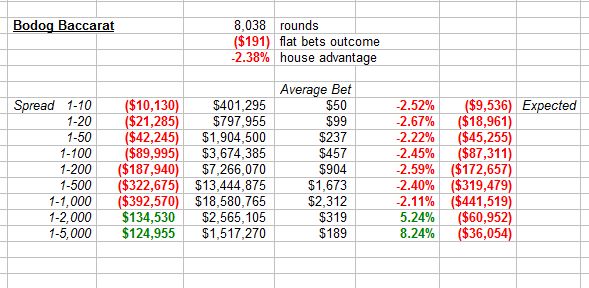
I don't make up these numbers. I just report on them.
The source for the baccarat data, regular readers will recall, was Bodog's online "practice" game - and I have a pile of pencil logs available to anyone who asks politely for them.
The mathematical explanation for the numbers you see above is pure logic.
If you bet a "tight" spread, then you will hit your maximum (your own, or the house's table limit) much sooner, and will "bet the max" for longer.
But if you are free to bet as much as necessary but do it only when necessary, you will routinely blow the house edge to smithereens and replace it with a player edge.
And very often, you will also WIN with less risk than seemingly more conservative strategies that consistently LOSE.
Here are the numbers from the full current set of blackjack outcomes, drawn from Bodog logs and from recent sessions with Ken Smith's Blackjack Strategy Trainer.

This was a "player friendly" data set overall, so the picture is just a little different.
The number for "house advantage" is green and positive (a house DISadvantage, for once), as it is when the BST outcomes are pulled out to stand alone:

The "max" spread (1-5,000) didn't come out on top this time, but the message remains loud and clear.
Table limits will kill you.
I'm well aware that sundry "experts" dismiss any data set, however large, as anecdotal, irrelevant and unique.
And of course, they're full of it.
If every data sample from every game of chance was unlike any other, casinos would be as vulnerable as players are.
As it is, the house always knows what to expect from a given game - and we do too.
There will always be short-term fluctuations and anomalies, courtesy of so-alled standard deviation.
But they're just meaningless blips in the big picture.
Right now I'm working on a web page that pulls together more than 75,000 baccarat outcomes over which (as with all the others!) I had no control.
I like this lot because they were published about 20 years ago in a couple of Zumma Publishing tomes that claimed to record actual baccarat shoes from casinos around the world.
My thanks to a strategy developer named Lee Jones for keying all those numbers into spreadsheets and making them available to me.
The books can still be found in most gambling bookstores, and from Zumma online.
I'm going to all this bother to further expose the fundamental lie that is the foundation for the casino-sponsored "conventional wisdom" that bamboozles millions of punters into believing that only blind luck can make them winners.
You read it here first: The myth of the unbeatable house advantage deserves a special place in history as the second most successful con of all time.
It works this way:
The house bias in any game has to be small - usually a lot less than 5.0% - so that it's possible for players to win once in a while, because without winners, there'd be no punters, and without punters, there'd be no casinos. And no billion-dollar bottom lines.
Because the house edge must be slight, it is necessary to persuade players that the bias is ultimately invincible, and to encourage them to bet in such a way that they "learn" to believe the con.
Table limits are one way to corral the herd and to influence player betting.
Another successful ploy is to pounce on anyone who demonstrates the slightest tendency toward progressive betting, and to persuade them that what they are doing is suicide.
Another is to manipulate data - and its interpretation - by ignoring the mathematical, logical truth that only progressive betting can win in the long run.
Clever stuff!
If you want to make consistent long-term headway against games with a negative expectation, you must be willing to give up what the casinos call "fun" (the right word is losing), and be ready to work a little harder.
And Target is only as complicated as you choose to make it.
The current win value for my strategy against the BST blackjack outcomes is +$108,560 with action of $980,325 indicating a 11.1% "hold" of action vs. a house disadvantage of 0.56% and an indicated win (AV x Action) of $5,490.
My way, there were 33 bets of $5,000 or more, 177 bets of $500 or more, 991 bets between $50 and $500, and 3,610 bets below $50.
The equivalent numbers for a "bare bones" approach would be +$11,530 with action of $192,000 indicating a 6.0% "hold" of action vs. a house disadvantage of 0.56% and an indicated win (AV x Action) of $1,075.
Playing it very safe, there woulda been just five bets of $5,000 or more, 58 bets of $500 or more, 251 bets between $50 and $500, and 4,497 bets below $50.
It's your call!
An important reminder: The only person likely to make money out of this blog is you, Dear Reader. There's nothing to buy, ever, and your soul is safe (from me, at least). Test my ideas and use them or don't. It's up to you. One more piece of friendly advice: If you are inclined to use target betting with real money against online "casinos" such as Bodog, spend a few minutes and save a lot of money by reading this._
Wednesday, September 28, 2011
BST just delivered its first killer session, giving me the perfect chance to prove that casino table limits are meant to thwart progressive betting.
_

(For updated information about Target's ongoing sports betting experiment, please go to the Sethbets website, or click here for an introduction to progressive betting, and here [20] and here [5] for current picks)
The latest BST screen shot looks good - $10,000-plus against a 13.6% house edge? Awesome!
But it hides the fact that I had to pull out my virtual wallet 42 times during the 90-minute session, meaning that if this had been real money, I would have LOST more than $30,000.
That would have put a very large dent in my winnings from the previous 11 BST blackjack sessions, no doubt prompting a chorus of toldyous from the army of doom-sayers who insist that casino games can't be beaten in the long run.
In fact, what the latest session proves is that like all casino table limits, BST's $1,000 betting cap paints a fatal bulls-eye on the back of anyone who dares to try using progressive betting to beat the house.
The house edge took off for the moon less than a dozen bets into this new session, and was for most of the time even higher than the big fat red number (13.6%) that it stood at when I finally got tired of losing.
I was deliberately playing a very aggressive version of Target, piling on the bucks to reach the table cap far quicker than I would have otherwise.
I was betting $1,000 every time after 15 rounds, and a lot more when double-downs and splits were called for!
You will find a full summary of the session in the latest BST log, and the first thing to notice is that after two failed turnaround attempts, the all-important "twins" (two wins in succession) showed up - and in real play, that would have been the end of the first deadly slump.
After that, there were thirty-five sets of twins, many of them with "siblings" attached, versus thirty-three failed turnaround tries.
The failures would, of course, have kept pushing bet values higher.
But the grouped wins would have negated the runaway house advantage every time.
And this is really what the whole concept of twins and wasted wins is all about.
If you bet fixed or random amounts, you are certain in the long run to fall victim to the house advantage.
So the casino will do all it can to push you into a red corner, shrinking your wiggle room and encouraging you to keep on betting a tight spread until you run out of money.
Then, hopefully, you'll take your plastic over to the cashier's window and use an ATM to draw some good money to throw after the bad.
You think ATMs are there for your convenience? Sure they are, the way non-slip floors and stun guns in a slaughterhouse are meant to keep the cattle happy!
An analysis of all 12 of the 2011 BST sessions provides a perfect lesson for anyone who's tired of trying to beat the odds at casino table games.
One obvious option for the frustrated loser is to go home and give up gambling forever.
An alternative is to get serious, and learn why the house advantage can be consistently exploited to generate profits that will never find their way back to the dealer's tray.
Let's first of all take a look at a breakdown of the BST sessions as a whole, starting with a summary of how a fairly conservative modification of Target would have performed:

The first thing to notice is that Mr. Smith's BST game (the most honest simulation I have ever found) hewed pretty closely to the expectation for perfect blackjack play.
Yes, it was an overall "player edge," but plus or minus 1.0% for 4,400 rounds is in the ballpark (or in the pit, if you'd rather use a casino cliche).
If you regularly read this blog, you will know that in any event, the final AV - actual value of the overall lost bets to number of bets percentage - matters a whole lot less than what happened when the house edge spiked and dipped along the way.
Most players are wiped out by short-lived swings against them because they bet the wrong amounts at the right time or vice versa!
Next, compare expectation with what actually happened - or would have happened if all of the BST hands had been dealt in the exact order in a casino that didn't impose a 1-200 bet spread limit.
Target's job is to maximize wins and minimize losses while delivering average wins that are bigger than average losses to make up for the fact that usually (although not in this example!) there are more losses than wins.
The average win value here was $190 and the average loss was $138.
The 37% difference will come as a surprise to all those experts who have said over the years, "Yeah, we get it, you bet more when you know you're going to win than when you know you're going to lose."
Target Betting gets the job done, folks.
The summary above includes a breakdown of the number of successful turnarounds and the average number of bets required for each recovery - 5.2, reduced to less than 5 when pushes are excluded.
Here's the next "shocker" from the BST sample (no surprise to me after all these years, but no doubt the numbers will prompt the usual claims from the usual shills that I must have cooked the books!).

The charts are revealing, but what counts the most are the win and action totals along the top of the summary.
You will see that betting a tight spread - and 1 to 10 is actually on the adventurous side for most players - does not even match the +0.89% expectation for the game, delivering a feeble +0.3% which as it happens was only marginally improved upon when the spread was pushed to 1-200.
The big surprise for most of you will be the action value when the spread is widened all the way to 1-5,000: $620,000 (average bet $140) versus $876,000 ($197) for spreading $5 to $500.
It is a myth enthusiastically bolstered by the casinos and their tame mythematicians that the wider your spread, the greater your risk and (by far) the bigger your loss at game over.
What crap! Freedom to make the right bet at the right time reduces your long-term exposure and increases your profit at the end of the day.
Never mind that "most people" can't afford the huge bets Target sometimes calls for.
This is not a feel-good blog offering penny-ante players a magic trick to help them get rich for little outlay.
It's about sound mathematics and truth, neither of which matters a damn to your average "recreational gambler."
Now let's drill down to the last of the 12 BST sessions, a horror story that handed the house an edge of almost 14 percent!
Nothing on earth could beat a house advantage that huge, right?

Well...once again, we see a huge difference between the overall action (a very telling yardstick for risk) when the betting spread is kept in check by tight table limits, and...when it isn't.
BST's table limit - generous, according to most blackjack players - required an overall average bet of $1,076.
Placing much bigger bets only when absolutely necessary instead of being forced by a low table limit to play a (doomed) game of constant catch-up, cut Target's average bet by almost 80 percent to a much more affordable $127.
What's very dramatically and convincingly demonstrated here is the sheer futility - the insanity! - of betting the way the casinos want you to, and their "expert" shills tell you to.
The old shills' chorus - Any amount bet against a negative expectation must always have a negative result - is only true if you let it be.
Bet as wide as you can and you will beat the house every time.
Bet any other way, and you'll go home with a lighter wallet.
It really is that simple.
I have used more underlines and italics and flashy colors in this entry than I usually do as a reminder that I'm not here to preach to the converted.
It's just as well, because there are precious few of those around the world!
I keep plugging away in an attempt to turn as many gamblers as I can away from betting practices that were, in effect, invented BY casinos FOR casinos.
And you should all know this: When a pit boss sidles up to you and tells you that if you keep on doing what you're doing, you are sure to lose, you're definitely betting right.
Progressive betting attracts unwanted attention, and that's why Target has so many rules, most of which are camouflage.
Some of them boost overall profits, too - but can be dispensed with as long as the core LTD+ rule isn't messed with.
As for giant house advantages, please jump back to the top of the page and check on the current numbers for Target's real-time, real money sports book trial.
To date, we have faced a "bookies' edge" that has not wavered much from 10.0%, or about ten times the expected HA for a straight game of blackjack.
With each day's selections always posted online ahead of game times, we're now ahead almost $160,000.
Bookies' edge: 10.1% Target's edge: 7.4%.
(Sometimes, only colors will do...)
An important reminder: The only person likely to make money out of this blog is you, Dear Reader. There's nothing to buy, ever, and your soul is safe (from me, at least). Test my ideas and use them or don't. It's up to you. One more piece of friendly advice: If you are inclined to use target betting with real money against online "casinos" such as Bodog, spend a few minutes and save a lot of money by reading this._

(For updated information about Target's ongoing sports betting experiment, please go to the Sethbets website, or click here for an introduction to progressive betting, and here [20] and here [5] for current picks)
The latest BST screen shot looks good - $10,000-plus against a 13.6% house edge? Awesome!
But it hides the fact that I had to pull out my virtual wallet 42 times during the 90-minute session, meaning that if this had been real money, I would have LOST more than $30,000.
That would have put a very large dent in my winnings from the previous 11 BST blackjack sessions, no doubt prompting a chorus of toldyous from the army of doom-sayers who insist that casino games can't be beaten in the long run.
In fact, what the latest session proves is that like all casino table limits, BST's $1,000 betting cap paints a fatal bulls-eye on the back of anyone who dares to try using progressive betting to beat the house.
The house edge took off for the moon less than a dozen bets into this new session, and was for most of the time even higher than the big fat red number (13.6%) that it stood at when I finally got tired of losing.
I was deliberately playing a very aggressive version of Target, piling on the bucks to reach the table cap far quicker than I would have otherwise.
I was betting $1,000 every time after 15 rounds, and a lot more when double-downs and splits were called for!
You will find a full summary of the session in the latest BST log, and the first thing to notice is that after two failed turnaround attempts, the all-important "twins" (two wins in succession) showed up - and in real play, that would have been the end of the first deadly slump.
After that, there were thirty-five sets of twins, many of them with "siblings" attached, versus thirty-three failed turnaround tries.
The failures would, of course, have kept pushing bet values higher.
But the grouped wins would have negated the runaway house advantage every time.
And this is really what the whole concept of twins and wasted wins is all about.
If you bet fixed or random amounts, you are certain in the long run to fall victim to the house advantage.
So the casino will do all it can to push you into a red corner, shrinking your wiggle room and encouraging you to keep on betting a tight spread until you run out of money.
Then, hopefully, you'll take your plastic over to the cashier's window and use an ATM to draw some good money to throw after the bad.
You think ATMs are there for your convenience? Sure they are, the way non-slip floors and stun guns in a slaughterhouse are meant to keep the cattle happy!
An analysis of all 12 of the 2011 BST sessions provides a perfect lesson for anyone who's tired of trying to beat the odds at casino table games.
One obvious option for the frustrated loser is to go home and give up gambling forever.
An alternative is to get serious, and learn why the house advantage can be consistently exploited to generate profits that will never find their way back to the dealer's tray.
Let's first of all take a look at a breakdown of the BST sessions as a whole, starting with a summary of how a fairly conservative modification of Target would have performed:

The first thing to notice is that Mr. Smith's BST game (the most honest simulation I have ever found) hewed pretty closely to the expectation for perfect blackjack play.
Yes, it was an overall "player edge," but plus or minus 1.0% for 4,400 rounds is in the ballpark (or in the pit, if you'd rather use a casino cliche).
If you regularly read this blog, you will know that in any event, the final AV - actual value of the overall lost bets to number of bets percentage - matters a whole lot less than what happened when the house edge spiked and dipped along the way.
Most players are wiped out by short-lived swings against them because they bet the wrong amounts at the right time or vice versa!
Next, compare expectation with what actually happened - or would have happened if all of the BST hands had been dealt in the exact order in a casino that didn't impose a 1-200 bet spread limit.
Target's job is to maximize wins and minimize losses while delivering average wins that are bigger than average losses to make up for the fact that usually (although not in this example!) there are more losses than wins.
The average win value here was $190 and the average loss was $138.
The 37% difference will come as a surprise to all those experts who have said over the years, "Yeah, we get it, you bet more when you know you're going to win than when you know you're going to lose."
Target Betting gets the job done, folks.
The summary above includes a breakdown of the number of successful turnarounds and the average number of bets required for each recovery - 5.2, reduced to less than 5 when pushes are excluded.
Here's the next "shocker" from the BST sample (no surprise to me after all these years, but no doubt the numbers will prompt the usual claims from the usual shills that I must have cooked the books!).
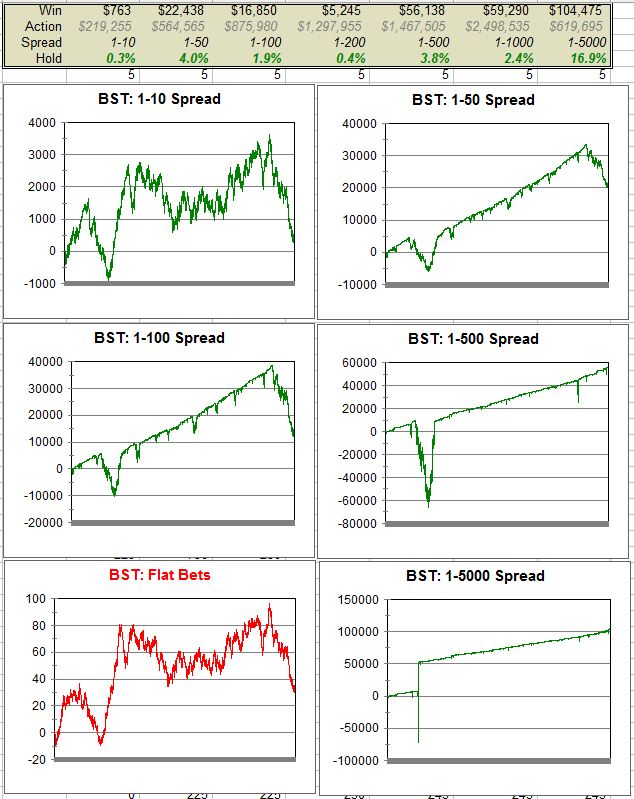
The charts are revealing, but what counts the most are the win and action totals along the top of the summary.
You will see that betting a tight spread - and 1 to 10 is actually on the adventurous side for most players - does not even match the +0.89% expectation for the game, delivering a feeble +0.3% which as it happens was only marginally improved upon when the spread was pushed to 1-200.
The big surprise for most of you will be the action value when the spread is widened all the way to 1-5,000: $620,000 (average bet $140) versus $876,000 ($197) for spreading $5 to $500.
It is a myth enthusiastically bolstered by the casinos and their tame mythematicians that the wider your spread, the greater your risk and (by far) the bigger your loss at game over.
What crap! Freedom to make the right bet at the right time reduces your long-term exposure and increases your profit at the end of the day.
Never mind that "most people" can't afford the huge bets Target sometimes calls for.
This is not a feel-good blog offering penny-ante players a magic trick to help them get rich for little outlay.
It's about sound mathematics and truth, neither of which matters a damn to your average "recreational gambler."
Now let's drill down to the last of the 12 BST sessions, a horror story that handed the house an edge of almost 14 percent!
Nothing on earth could beat a house advantage that huge, right?

Well...once again, we see a huge difference between the overall action (a very telling yardstick for risk) when the betting spread is kept in check by tight table limits, and...when it isn't.
BST's table limit - generous, according to most blackjack players - required an overall average bet of $1,076.
Placing much bigger bets only when absolutely necessary instead of being forced by a low table limit to play a (doomed) game of constant catch-up, cut Target's average bet by almost 80 percent to a much more affordable $127.
What's very dramatically and convincingly demonstrated here is the sheer futility - the insanity! - of betting the way the casinos want you to, and their "expert" shills tell you to.
The old shills' chorus - Any amount bet against a negative expectation must always have a negative result - is only true if you let it be.
Bet as wide as you can and you will beat the house every time.
Bet any other way, and you'll go home with a lighter wallet.
It really is that simple.
I have used more underlines and italics and flashy colors in this entry than I usually do as a reminder that I'm not here to preach to the converted.
It's just as well, because there are precious few of those around the world!
I keep plugging away in an attempt to turn as many gamblers as I can away from betting practices that were, in effect, invented BY casinos FOR casinos.
And you should all know this: When a pit boss sidles up to you and tells you that if you keep on doing what you're doing, you are sure to lose, you're definitely betting right.
Progressive betting attracts unwanted attention, and that's why Target has so many rules, most of which are camouflage.
Some of them boost overall profits, too - but can be dispensed with as long as the core LTD+ rule isn't messed with.
As for giant house advantages, please jump back to the top of the page and check on the current numbers for Target's real-time, real money sports book trial.
To date, we have faced a "bookies' edge" that has not wavered much from 10.0%, or about ten times the expected HA for a straight game of blackjack.
With each day's selections always posted online ahead of game times, we're now ahead almost $160,000.
Bookies' edge: 10.1% Target's edge: 7.4%.
(Sometimes, only colors will do...)
An important reminder: The only person likely to make money out of this blog is you, Dear Reader. There's nothing to buy, ever, and your soul is safe (from me, at least). Test my ideas and use them or don't. It's up to you. One more piece of friendly advice: If you are inclined to use target betting with real money against online "casinos" such as Bodog, spend a few minutes and save a lot of money by reading this._
Tuesday, September 27, 2011
For many people, gambling is a guilty pleasure, and they think of losing as inevitable retribution. But here's a thought: You deserve to win!
_

(For updated information about Target's ongoing sports betting experiment, please go to the Sethbets website, or click here for an introduction to progressive betting, and here [20] and here [5] for current picks)
Guilt-ridden gamblers who don't refer to Las Vegas as "Sin City" sometimes call it "Lost Wages" - a tortured pun which confirms the way a lot of people feel about betting.
Me, I've never understood why if gambling is a sin punishable by losses, building casinos and luring sinners in isn't an even bigger crime against all that's good and righteous.
But instead, the facilitators of bad behavior on the part of the weak and the greedy (their view of themselves, not mine!) bank billions and strut around like honest, upright citizens worthy of our respect and gratitude.
I don't count gambling as a sin except when a self-destructive urge hurts other people too, but I do think of losing as a shame because it's avoidable.
The latest BST screen capture above is not as impressive as the last, and the accompanying log shows why: a total of 12 $1,000 buy-ins, including the first, were needed and the final profit was hard won because of the tight table limit.
I can't over-stress how dangerous a narrow betting spread will always turn out to be in the end, or how foolish it is to risk money on a low-limit game.
Wiggle room is the key to exploiting the win-loss patterns that exist in every game of chance, because without it, long-term profit depends on luck, and luck is nobody's ally for long.
Even the house has to be ready for temporarily painful downturns, relying on the certainty that the lucky stiff who just took it for millions will lose it all back soon enough.
The big plus for the house, of course, is that most of the time, it's "playing" with our money.
We used our hard-earned cash to buy a pile of chips, and the house doesn't have to give it back until the dealing's done.
And while the house doesn't determine bet values round by round, it counts on us to mess up that all-important task, setting limits that are designed to make failure that much easier for us.
It makes no sense to complain that progressive betting is "too risky" and keep going back to the tables hoping that this time the story will have a happy ending.
Casino operators and bookies know full well that very often, money has to go out before it can come back in with more behind it, and the same truth applies to pretty much every commercial venture.
And that's what Target Betting is, when you get right down to it: a business venture as dedicated to sound money management and the pursuit of profit as any other.
Sometimes, making a buck can be hard work, but as my dad used to say before he took another swig of beer and went back to his nap, hard work never hurt anybody. Else.
As in the new BST example, it's best to expect that you will lose more bets than you win, and this time the house edge was -27/398 = 6.8%, or about seven times negative expectation for single-deck blackjack.
Total action was about $70,000 so the final win of $2,650 represented a decent but not spectacular "hold" of all the money in play back and forth.
That, of course, is impossible according to Prof. Expert, Ph.D., but that just reminds me of a sign I once saw in a design center: "The difficult, we do immediately - the impossible takes a little longer." Amen!
An important reminder: The only person likely to make money out of this blog is you, Dear Reader. There's nothing to buy, ever, and your soul is safe (from me, at least). Test my ideas and use them or don't. It's up to you. One more piece of friendly advice: If you are inclined to use target betting with real money against online "casinos" such as Bodog, spend a few minutes and save a lot of money by reading this._

(For updated information about Target's ongoing sports betting experiment, please go to the Sethbets website, or click here for an introduction to progressive betting, and here [20] and here [5] for current picks)
Guilt-ridden gamblers who don't refer to Las Vegas as "Sin City" sometimes call it "Lost Wages" - a tortured pun which confirms the way a lot of people feel about betting.
Me, I've never understood why if gambling is a sin punishable by losses, building casinos and luring sinners in isn't an even bigger crime against all that's good and righteous.
But instead, the facilitators of bad behavior on the part of the weak and the greedy (their view of themselves, not mine!) bank billions and strut around like honest, upright citizens worthy of our respect and gratitude.
I don't count gambling as a sin except when a self-destructive urge hurts other people too, but I do think of losing as a shame because it's avoidable.
The latest BST screen capture above is not as impressive as the last, and the accompanying log shows why: a total of 12 $1,000 buy-ins, including the first, were needed and the final profit was hard won because of the tight table limit.
I can't over-stress how dangerous a narrow betting spread will always turn out to be in the end, or how foolish it is to risk money on a low-limit game.
Wiggle room is the key to exploiting the win-loss patterns that exist in every game of chance, because without it, long-term profit depends on luck, and luck is nobody's ally for long.
Even the house has to be ready for temporarily painful downturns, relying on the certainty that the lucky stiff who just took it for millions will lose it all back soon enough.
The big plus for the house, of course, is that most of the time, it's "playing" with our money.
We used our hard-earned cash to buy a pile of chips, and the house doesn't have to give it back until the dealing's done.
And while the house doesn't determine bet values round by round, it counts on us to mess up that all-important task, setting limits that are designed to make failure that much easier for us.
It makes no sense to complain that progressive betting is "too risky" and keep going back to the tables hoping that this time the story will have a happy ending.
Casino operators and bookies know full well that very often, money has to go out before it can come back in with more behind it, and the same truth applies to pretty much every commercial venture.
And that's what Target Betting is, when you get right down to it: a business venture as dedicated to sound money management and the pursuit of profit as any other.
Sometimes, making a buck can be hard work, but as my dad used to say before he took another swig of beer and went back to his nap, hard work never hurt anybody. Else.
As in the new BST example, it's best to expect that you will lose more bets than you win, and this time the house edge was -27/398 = 6.8%, or about seven times negative expectation for single-deck blackjack.
Total action was about $70,000 so the final win of $2,650 represented a decent but not spectacular "hold" of all the money in play back and forth.
That, of course, is impossible according to Prof. Expert, Ph.D., but that just reminds me of a sign I once saw in a design center: "The difficult, we do immediately - the impossible takes a little longer." Amen!
An important reminder: The only person likely to make money out of this blog is you, Dear Reader. There's nothing to buy, ever, and your soul is safe (from me, at least). Test my ideas and use them or don't. It's up to you. One more piece of friendly advice: If you are inclined to use target betting with real money against online "casinos" such as Bodog, spend a few minutes and save a lot of money by reading this._
Sunday, September 25, 2011
To make the Big Leap to Target (aka the BLT) you just have to forget everything you think you know, and start believing in two simple little truths.
_

(For updated information about Target's ongoing sports betting experiment, please go to the Sethbets website, or click here for an introduction to progressive betting, and here [20] and here [5] for current picks)

I could go on posting examples like the one at the top of this entry until I'm blue in the face, and readers who subscribe to the conventional wisdom about casino games of chance would keep on saying the big wins are either a fiddle or a fluke.
I can deal with the fraud charge by linking each new funny-munny success to a web page that expands the example into screen shots saved every 30 bets or so from the beginning to the end of the session. Plus a scan of the log from the same session, highlighting all the paired wins that made it possible - unavoidable! - to beat the odds.
But changing negative attitudes is a much bigger challenge.
Let's start with the law of large numbers above.
It's not wrong, obviously - it's just irrelevant when progressive betting is applied to smooth out the ups and downs of standard deviation, and exploit patterns or trends that can be relied upon no matter how ginormous a data set may be.
Progressive betting is widely derided by everyone from casino personnel, who have an obvious interest in promoting the notion that their games are ultimately unbeatable, to mathematicians, whose agenda is less clear.
The logical alternatives to progressive betting are fixed (flat) or random betting, which arithmetic confirms cannot prevail against a negative game, and regressive betting, which reduces wagers in a downturn and so is obviously even worse than the other two methods.
Most people reject progressive betting because they are brain-washed into believing that it cannot win in the long run.
A small minority accepts that progressive betting can be effective, but thinks of it as too risky or too scary to use in a situation where the objective is to have fun and hopefully make a little money before going home.
I applaud everyone who gambles for fun, and thank them for contributions without which there would be no casinos.
But Target is about winning.
And however small the minority I'm in may be, I insist on believing that winning is much more fun than losing.
It can be risky, certainly, and hard work at times.
But it is far from mathematically impossible.
Progressive betting makes us think of a bazillion bets as just a long string of "series" or sequences of bets, each of which begins with one or more losses and ends with the recovery of money lost in that series, plus a small profit.
A series can begin with one or more winning bets, but does not technically qualify for Target's definition of a series until one or more losses lead to a recovery, or turnaround.
Breaking up what would otherwise be an infinite string of ups and downs makes long-term winning not only easier, but inevitable.
But the You Can't Win!!! mentality is an accurate prophecy for the vast majority of casino gamblers, all of whom go into games with too little money and without a long-term plan.
All I wanted to know when I started my insane quest for the impossible, as it has been characterized by the YCW brigade, was whether or not the house edge could be beaten in the long run.
If the Martingale or double-up method is given unlimited funds and free access to casino games - neither of which is true in the real world - then it can be claimed to be the easiest antidote to the house advantage.
But in reality, it has to deal with table limits that for practical purposes top out at around $25,000 in my neighborhood, as well as vigilant casino personnel who treat "Martingalers" as if they have come to rob the joint at gunpoint.
Table limits are far tighter outside of Nevada and New Jersey because a casino's interests are best served by squeezing progressive bettors into as small a box as the local market will allow.
The only large number that a Target player is concerned with is the spread between the minimum and maximum bets permitted at a given location.
The smaller the spread, the tougher the challenge.
The two truths that I refer to in today's heading are progressive betting's proven status as the only way to win in the long run, and the existence of patterns of wins and losses that can be consistently exploited for profit.
The patterns I'm talking about only relate to bet values when progressive betting is applied to them.
So -1,-1,-1,+1,+1 is a losing sequence until Target bets are applied (-1,-1,-1,+1,+3) or double-up determines bet amounts (-1,-2,-4,+8,+1).
In the Target example above, the series took five bets to resolve, falling back to a minimum wager ready for the next series, and double-up needed four bets.
Random betting may or may not have recovered lost chips from three bets in the two winners that came after them.
The fixed or flat bettor was, of course, out of luck.
In both blackjack and baccarat, which have a house advantage of less than 1.5% in the long run, you can count on 60% of all recovery series to turn around in FOUR bets or fewer.
Assuming that you are using progressive betting to delineate series in the first place, that is.
It then stands to sense that if the money won in all those short series does not exceed the combined value of chips lost when series run five bets or more, you might as well write the casino a check and stay at home.
But longer series don't lose. They just don't win as quickly.
My aim in all my recent posts has been to challenge readers to pull up Ken Smith's BST game or any alternative that they are comfortable with, and play first the way they always have, then with Target.
The existence of the rhythm or pattern of wins and losses that I keep going on about then becomes blindingly obvious.
Baccarat is a much harder slog than blackjack, because it lacks splits and double-downs and bonus-paid naturals, so while the overall rhythm is much the same as for the more popular (better) game, it takes longer to pay off.
Given the four-bets-or-less statistic I quoted earlier, it's worth the time to tackle a fair (but free) table game simulation that limits double-up to, say, four losses before a series is abandoned.
So -5,-10,-20,+40 pays a profit of 5 (+6.7%), and -5,-10,-20,-40 ends with a LOSS of 75 (-100%!).
Is it possible to win enough "plus fives" to cover the cost of a lesser number of "minus seventy-fives"?
In blackjack, your long-term prospects are pretty good and certainly better than betting without smart and consistent money management.
Give it a go: You'll have fun, even against a funny-munny game.
In baccarat, you'll likely lose a little - especially if you ignore the numbers and put (fake) money on Banker!
I mention the experiment simply to illustrate the difference between the two casino card games with the lowest house advantage.
Now, what if you were to apply the same four losers limit but make NB=PBx3 or x4 or x5 instead of x2?
Now you're talking!
Try it for a while, if only to convince yourself of the power of progressive betting.
Then you can learn all the Target rules and variations, and start making real money.
I began this blog early in 2009 hoping to convince as many people as possible that losing money in a casino is not as inevitable as death and taxes.
I get enough positive feedback from around the world (including Russia and China!) to keep me going.
And the more Target costs casinos and bookies everywhere, the happier I will be.
It's an uphill battle, of course. But they make for the most satisfying wins...just like Target.
An important reminder: The only person likely to make money out of this blog is you, Dear Reader. There's nothing to buy, ever, and your soul is safe (from me, at least). Test my ideas and use them or don't. It's up to you. One more piece of friendly advice: If you are inclined to use target betting with real money against online "casinos" such as Bodog, spend a few minutes and save a lot of money by reading this._

(For updated information about Target's ongoing sports betting experiment, please go to the Sethbets website, or click here for an introduction to progressive betting, and here [20] and here [5] for current picks)

I could go on posting examples like the one at the top of this entry until I'm blue in the face, and readers who subscribe to the conventional wisdom about casino games of chance would keep on saying the big wins are either a fiddle or a fluke.
I can deal with the fraud charge by linking each new funny-munny success to a web page that expands the example into screen shots saved every 30 bets or so from the beginning to the end of the session. Plus a scan of the log from the same session, highlighting all the paired wins that made it possible - unavoidable! - to beat the odds.
But changing negative attitudes is a much bigger challenge.
Let's start with the law of large numbers above.
It's not wrong, obviously - it's just irrelevant when progressive betting is applied to smooth out the ups and downs of standard deviation, and exploit patterns or trends that can be relied upon no matter how ginormous a data set may be.
Progressive betting is widely derided by everyone from casino personnel, who have an obvious interest in promoting the notion that their games are ultimately unbeatable, to mathematicians, whose agenda is less clear.
The logical alternatives to progressive betting are fixed (flat) or random betting, which arithmetic confirms cannot prevail against a negative game, and regressive betting, which reduces wagers in a downturn and so is obviously even worse than the other two methods.
Most people reject progressive betting because they are brain-washed into believing that it cannot win in the long run.
A small minority accepts that progressive betting can be effective, but thinks of it as too risky or too scary to use in a situation where the objective is to have fun and hopefully make a little money before going home.
I applaud everyone who gambles for fun, and thank them for contributions without which there would be no casinos.
But Target is about winning.
And however small the minority I'm in may be, I insist on believing that winning is much more fun than losing.
It can be risky, certainly, and hard work at times.
But it is far from mathematically impossible.
Progressive betting makes us think of a bazillion bets as just a long string of "series" or sequences of bets, each of which begins with one or more losses and ends with the recovery of money lost in that series, plus a small profit.
A series can begin with one or more winning bets, but does not technically qualify for Target's definition of a series until one or more losses lead to a recovery, or turnaround.
Breaking up what would otherwise be an infinite string of ups and downs makes long-term winning not only easier, but inevitable.
But the You Can't Win!!! mentality is an accurate prophecy for the vast majority of casino gamblers, all of whom go into games with too little money and without a long-term plan.
All I wanted to know when I started my insane quest for the impossible, as it has been characterized by the YCW brigade, was whether or not the house edge could be beaten in the long run.
If the Martingale or double-up method is given unlimited funds and free access to casino games - neither of which is true in the real world - then it can be claimed to be the easiest antidote to the house advantage.
But in reality, it has to deal with table limits that for practical purposes top out at around $25,000 in my neighborhood, as well as vigilant casino personnel who treat "Martingalers" as if they have come to rob the joint at gunpoint.
Table limits are far tighter outside of Nevada and New Jersey because a casino's interests are best served by squeezing progressive bettors into as small a box as the local market will allow.
The only large number that a Target player is concerned with is the spread between the minimum and maximum bets permitted at a given location.
The smaller the spread, the tougher the challenge.
The two truths that I refer to in today's heading are progressive betting's proven status as the only way to win in the long run, and the existence of patterns of wins and losses that can be consistently exploited for profit.
The patterns I'm talking about only relate to bet values when progressive betting is applied to them.
So -1,-1,-1,+1,+1 is a losing sequence until Target bets are applied (-1,-1,-1,+1,+3) or double-up determines bet amounts (-1,-2,-4,+8,+1).
In the Target example above, the series took five bets to resolve, falling back to a minimum wager ready for the next series, and double-up needed four bets.
Random betting may or may not have recovered lost chips from three bets in the two winners that came after them.
The fixed or flat bettor was, of course, out of luck.
In both blackjack and baccarat, which have a house advantage of less than 1.5% in the long run, you can count on 60% of all recovery series to turn around in FOUR bets or fewer.
Assuming that you are using progressive betting to delineate series in the first place, that is.
It then stands to sense that if the money won in all those short series does not exceed the combined value of chips lost when series run five bets or more, you might as well write the casino a check and stay at home.
But longer series don't lose. They just don't win as quickly.
My aim in all my recent posts has been to challenge readers to pull up Ken Smith's BST game or any alternative that they are comfortable with, and play first the way they always have, then with Target.
The existence of the rhythm or pattern of wins and losses that I keep going on about then becomes blindingly obvious.
Baccarat is a much harder slog than blackjack, because it lacks splits and double-downs and bonus-paid naturals, so while the overall rhythm is much the same as for the more popular (better) game, it takes longer to pay off.
Given the four-bets-or-less statistic I quoted earlier, it's worth the time to tackle a fair (but free) table game simulation that limits double-up to, say, four losses before a series is abandoned.
So -5,-10,-20,+40 pays a profit of 5 (+6.7%), and -5,-10,-20,-40 ends with a LOSS of 75 (-100%!).
Is it possible to win enough "plus fives" to cover the cost of a lesser number of "minus seventy-fives"?
In blackjack, your long-term prospects are pretty good and certainly better than betting without smart and consistent money management.
Give it a go: You'll have fun, even against a funny-munny game.
In baccarat, you'll likely lose a little - especially if you ignore the numbers and put (fake) money on Banker!
I mention the experiment simply to illustrate the difference between the two casino card games with the lowest house advantage.
Now, what if you were to apply the same four losers limit but make NB=PBx3 or x4 or x5 instead of x2?
Now you're talking!
Try it for a while, if only to convince yourself of the power of progressive betting.
Then you can learn all the Target rules and variations, and start making real money.
I began this blog early in 2009 hoping to convince as many people as possible that losing money in a casino is not as inevitable as death and taxes.
I get enough positive feedback from around the world (including Russia and China!) to keep me going.
And the more Target costs casinos and bookies everywhere, the happier I will be.
It's an uphill battle, of course. But they make for the most satisfying wins...just like Target.
An important reminder: The only person likely to make money out of this blog is you, Dear Reader. There's nothing to buy, ever, and your soul is safe (from me, at least). Test my ideas and use them or don't. It's up to you. One more piece of friendly advice: If you are inclined to use target betting with real money against online "casinos" such as Bodog, spend a few minutes and save a lot of money by reading this._
Subscribe to:
Posts (Atom)