Tuesday, February 16, 2010

Time to make like a monk and keep chanting the phrases long term and just numbers as a reminder that it's the math that rules each day.

_
It was probably a mistake to pick any selections at all Monday, but that would be Tuesday morning quarterbacking if we weren't talking basketball!

I am doing my level best to stop whooping and hollering, chanting a mantra that puts the onus squarely on the numbers and ignores team identities and, to some extent, applicable odds.

Yesterday, there were 10 CBB clashes and underdogs came out on top in just two of them.

I made three picks and caught one victorious dog - the "wrong" one because it did not coincide with the only maximum bet on the 50x list.

It stands to sense that we are not going to do well on days when dogs under-perform as a group, unless we "get lucky," and it is foolish to rely on luck at all.

We are back to seven picks for Tuesday, none of them especially attractive from a subjective standpoint, but so what?

Here are today's updates:


Wednesday, February 17 at 10:00am:


There isn't an optimistic angle from which to view what's been happening to the 7-dog trial recently.

The 50x rules set came within a single large bet of achieving complete recovery and setting an all-time high for this 100-day (now 105-day) demonstration, and now it's headed south at a rapid clip.

The 5x rules set bets less and so loses less, but as long as underdogs fail to come close to a 40%-plus DWR, gravity is having its evil way there, too.

Dognostics will be doing a happy dance right now, repeating the ancient axiom that in the world of random numbers, if you create a rule for the future based upon what has been observed in the past, three words apply: It. Won't. Work.

As it happens, the current 50x slump is almost an exact duplicate of one that occurred very early in the trial, when target betting climbed slowly and elegantly to a profit of $5,425 by Day 9, then leaped off a cliff (by degrees!) until it hit -$15,023 three weeks later.

Then, dogs recouped their departure from expectation, and the numbers bounced back to where we needed them to be.

What we are seeing now is a far more rapid downturn made worse by the fact that only one series is betting the max, so even 4 right picks out of 7 don't help much if the day's single big bet is not among the winners.

Tuesday was a decidedly dismal day for dogs with a 14% DWR - six "upsets" in 33 contests, and we managed to nail three of them.

Let's hope today is kinder to us!

An important reminder: The only person likely to make money out of this blog is you, Dear Reader. There's nothing to buy, ever, and your soul is safe (from me, at least). Test my ideas and use them or don't. It's up to you.
_

Monday, February 15, 2010

Our more aggressive approach slips back into yo-yo mode, and recovery may be slowed down by the Vancouver Winter Olympics. But it will happen.

_
The latest charts and summaries tell it all (which won't stop me from adding a few words in a minute!)


It's going to be quite a challenge to find seven bets a day while the NHL takes a break to avoid distracting sports fans from the Vancouver games, and today the NBA schedule is also bare.

As you can see, what I decided to do was apply selections where wins would do the most good, and the lone max bet in the 50x list certainly qualifies.

In the long run, it doesn't matter which pick or what odds are applied to which series, so this is merely a real-time expedient.

The 5x trial has suffered a couple of nasty setbacks because of disappointing DWRs over the weekend, but I still live in hope that an eventual turnaround is possible.

The 50x alternate fell back Sunday after a Saturday boost, and the matching chart below confirms that yo-yo mode is nothing new when the spread is from 1 to 50.

History also shows that 5x is considerably more volatile and ultimately more "dangerous" in relative terms than what at first blush seems to be a riskier option.

Think of it this way: the 50x update above shows that unrecovered LTDs before game time today total $16,965 or roughly 3.5x the maximum bet.

The unrecovered total for 5x is higher at $21,300 and is 43x the max.

Which set of rules is most likely to prevail soonest?

That was a rhetorical question...!


I now have to accept that I have no idea what's going on in the world of InvestaPick!

Valentine's Day brought a right pick at -120 for the ailing IPE series, and today it shows up as a win worth $32.50 or a tiny fraction of the losses racked up by the recent eight-bet slump.

As regular readers know, I modified the target betting rules for all three of the IP series dating back to January 1, 2009, to take into account the fund's tendency to accept odds of -110 or worse.

A target betting rule that dominates right now is that no bet can be more than 10x the previous bet (PB), so doing things my way, Sunday's win would have risked $1,000 and earned $830 towards recovery.

Today's pick (if there is one - I won't know until the website confirms it) should be at $4,000 to recover the $3,600 LTD remaining from the recent slump, keeping in mind that next bet (NB) values always assume a 90% payback at best.

But that is not how IP manages its money.

Oh, well: They seem to have a pretty impressive track record overall, so perhaps they know best.

Right now, the bottom line number for the IPE series using target betting rules is $5,434 in profits since January 1 last year, or +96% on an initial investment of $5,000 after fees of about $700 have been deducted.

The equivalent number for IP's much more conservative (and perhaps much smarter) set of rules is +$579 gross, or a small loss for this one series after deduction of 14 x $49.

One big difference is that so far, IP has dropped just $88 into the red in 13-plus months, whereas at one point, the target betting method was over $4,000 in the hole, risking a far larger percentage of its initial bankroll.clai

As always, it is a matter of balancing potential risk against potential reward.

InvestaPick claims to double investors' money in a year or so, a process that using the tried and true "rule of 72" would take a decade and a half at current bank interest rates.

That is a promise that deserves some respect. As long as it is not broken, that is.

_
An important reminder: The only person likely to make money out of this blog is you, Dear Reader. There's nothing to buy, ever, and your soul is safe (from me, at least). Test my ideas and use them or don't. It's up to you.

Sunday, February 14, 2010

Tough times for tortoises, but our hare is marching in the right direction again, headed for an all-time high...

_
Yesterday's all-ice lineup left the 5x 7-dog trial drowning in red ink, but there were big fat green numbers for the 50x alternate because the Dallas Stars delivered +115 from a 3-0 demolition of the Phoenix Coyotes.

Last night when I whooped with glee at a $5,000 right pick in the wake of two wrong ones on Thursday and Friday, my wife said with alarm that I was beginning to sound like a sports fan.

"You'll be watching games and guzzling Buzzwater next," she said.

Ain't going to happen. But I have always liked to win, believing that participation has it over spectating any day of the week.

And yes, I understand that betting on a game is not participating on the same scale as skating up and down and putting your teeth in jeopardy, but it is at least more active than simply watching from an armchair.

Clearly, there are bumpy days ahead for the cautious 5x trial, because six out of seven bets are at the max, and when the DWR is below par (as it was yesterday), the bankroll is sure to suffer a setback.

Dogs won just four of 11 NHL games Saturday and we caught two of them.

Let's take a look at today's summaries:-


Last time, I mentioned the statistical probability that each of the seven series in the dog trial would by now have won roughly the same number of bets apiece overall, and that's close to how it has turned out so far.

As of this morning, we had placed 716 bets in 102 days, with underdogs winning 43% vs. an expectation (one that dognostics will dismiss as a faint hope) of 45%.

We would therefore expect that each of the seven series would see, on average, a little over 43 wins to date.

Here are the actual numbers...


As you can see, the 7-line average is 44 wins to date.

Series 2,5 and 6 are over the average so far, and #6 (at 55) is way over.

Series 1,3,4 and 7 are below par.

Statistical pedants will confirm that neither 716 bets nor 102 days qualify as "representative samples" but as is always the case when reality meets theory, they are all that we have and they are what they are.

It is safe to bet that as time goes by, the disparities will fade away and statistical expectation will be satisfied.

At this point, if we had been flat betting since November 1, 2009, the 5x trial would be a 1x trial and would be in about as much trouble as it is right now with target betting.

The 50x trial outcome would be moot, because it too would be a 1x loser.

On the 5x side, target betting rules took us to a high of +$6,000 on January 18, then led us (temporarily!) into negative numbers.

Capping the max at 50x from the same $100 minimum delivered a win high of $59,800 on Feb 10 which I am hoping (but not necessarily expecting) will be topped today.

InvestaPick's IPE series finally broke an eight-bet losing streak Saturday with $130 on the Philly Flyers over the Montreal Canadiens to win $108.33 at -120, and I can't wait to see the value of today's wager.

The fund has taken a $2,485 hit in the slump that (hopefully) just ended, and I assume that loss will not be written off.

Like everyone else without money on the line with IP, I am just going to have to wait and see...


An important reminder: The only person likely to make money out of this blog is you, Dear Reader. There's nothing to buy, ever, and your soul is safe (from me, at least). Test my ideas and use them or don't. It's up to you.
_

Saturday, February 13, 2010

So far, it's been mostly a comeback week for slow-and-steady-wins-the-race and a hare-raising time for the "more aggressive" approach.

_
The updates below confirm that the big problem for the 5x 7-dog trial is that far too many bets are at the maximum level, while the 50x alternative has risked the max only 3% of the time and right now has just one monster bet in play each day.

It stands to sense that the more series we have betting the max each day, the more we are at the mercy of the wild fluctuations in the DWR that can be seen day after day and week after week.

It's the same as flat or fixed betting, in other words, and we all know what a bad idea that is.

I talked about objectivity last time, and the failure of two successive bets in the 50x trial make it tempting to argue that when the wager gets above a certain level, a more rigorous selection process should apply.

But I have my doubts about that.

When results for each of the seven separate series or lines in the trial are analyzed, we see that there is little variation between win rate percentages and win values.

The 50x data shows that winning days outnumber losing ones, but what is much more important, the average win value still, after two crappy days, exceeds the average loss value by almost 20%.

The same does not apply for the 5x trial, where there have also been more up days than down, but the AWV is just 77% of the ALV. Bad, bad news...

Here are today's updates...


An important reminder: The only person likely to make money out of this blog is you, Dear Reader. There's nothing to buy, ever, and your soul is safe (from me, at least). Test my ideas and use them or don't. It's up to you.
_

Friday, February 12, 2010

A cold-blooded, objective selection process is what we're always aiming for. But sometimes, objectivity is easier said than done!

_
C'est la guerre, as they say en France...Thursday provided another nice boost for the 5x limit 7-dog trial, but the Florida Panthers never stood a snowball's chance in hell against Vancouver and could not manage even a single goal.

So the 50x shadow tracking sheet took a hit that was at least softened by the fact that while the Panthers choked, five of the other six selections delivered the goods.

It would have been great to see the one and only max bet on the 50x list come in at +130, just as it would be nifty to win the lottery once in a while.

But as often happens, reality had other ideas.

One of the great appeals of this adventure - one that I was gently bullied into by my friend "Pete" - was that I have never been much of a sports fan, and so convinced myself that I could accept selections provided purely by the numbers.

In the first few weeks, I dutifully put money down on dogs within the +100 to +180 range in the order that they popped up on the schedule.

That got old very fast.

It was way too arbitrary, and the more I learned, the quicker I was able to recognize bets that were too silly to consider (much like Royal Match on a blackjack layout!).

That's when I narrowed the range, while still tracking ALL underdog options within the <= +180 range to satisfy skeptics who were poised to accuse me of cherry-picking and book-cooking.

Along the way, I have become familiar with individual teams, and hard as I try not to be interested in their day-to-day ups and downs, I'm happiest when the numbers permit me to back the ones I have grown to like the most.

I really have to try harder to fight that scary slide into sports fandom!

I don't doubt that once this approach to sportsbook betting becomes a permanent part of my daily routine, I will develop a selection process that fulfills the objectivity requirement.

In the meantime, I am confident that because in the end the overall dog win rate or DWR is what determines long term profit or loss, the way I have been picking bets during the past 100 days has not done any statistical damage.

After all, whatever method I use to make my selections, picks are always posted way ahead of game time and I can never know in advance what the final scores will be.

That does not prevent some readers from expressing doubts, and all I can say to them is that 99.99% of the time, today's bets will be found here at least an hour before online bookies shut their virtual windows.

Once in a blue moon, because of ISP breakdowns or whatever, I may post a pick a few minutes after a game has started.

That does not make the selection any less valid (it's the odds that count!) but it does mean that those who want to will be unable to make the same bet, and I apologize for that.

Here's today's info...


An important reminder: The only person likely to make money out of this blog is you, Dear Reader. There's nothing to buy, ever, and your soul is safe (from me, at least). Test my ideas and use them or don't. It's up to you.
_

Thursday, February 11, 2010

"Past performance is not a guarantee of future profitability" (or so they say on Wall Street). But history is the only crystal ball available to us.

_
Below is the promised data that compares InvestaPick's triple-index results, and what coulda been achieved using the same set of target betting rules that yesterday pulled the 7-dog trial out of the mire.

OK, OK, the 7DT is still in deep doggy doo as long as a 1 to 5 spread is the rule.

But regular readers will know that I have always preached that a wide spread is the key to beating the odds, and what the difference between the 5x and the 50x max results does is prove my point!

I am still confident that the 5x slump can be turned around, especially after Wednesday's underdog surge, but have to confess that I don't care what happens as much as I once did.

The 7DT assumes a minimum bet of $100, remember, and the 50x rule delivers a 99-day profit of $59,800 or 16.6% of total action.

Drop the minimum bet all the way down to $25 and the performance described in my earlier post today still amounts to almost $15,000, or about $150 a day in overall winnings.

Not too shaggy, as they say in Las Vegas. (That's a bad British pun).

It has been a feeble Feb for IP's IPE "index" with nary a win since January 30, with two days skipped and eight losses for eight.

Even target betting is, as you would expect, hard hit by eight successive losses, but the way it handles them is less painful than InvestaPick's newly revealed loss-taking policy.

Another couple of losing days and target betting will also be in the red against the same set of selections, but right now, my way has us still three grand in the green.

Here's the IPE summary:-


IP's IPC and IPW indexes are doing much better than the IPE data set, but not as well as they woulda if target betting rules had been applied since January 1, 2009.

Here's the relevant information:


The summary in the last screen cut above shows the contrast between IP's overall performance and target betting's.

I will say again that what you see here does not mean that the wizards behind InvestaPick (and in spite of the woes and worrying omissions in the IPE summary, I am still hoping they are not charlatans like Oz) should change their approach.

If their numbers are honest and true, they are at least 20x ahead of the returns offered by banks and bonds, and their risk factor is not much higher than for more conventional investment plans.

If it ain't broke, why fix it?

And please don't tell me that you can't lose it all on Wall Street, because for the last year or so, we have been reading about countless thousands of cautious folk who did just that with no inkling of the risks faced by their life savings.

An important reminder: The only person likely to make money out of this blog is you, Dear Reader. There's nothing to buy, ever, and your soul is safe (from me, at least). Test my ideas and use them or don't. It's up to you.
_

Six right picks out of seven! Again! And all I can say about that is...It's about bloody time! The bad news: 5x needs a lot more days like Feb 10!

_
The charts below say it all, really.

Or almost.

What they may not communicate is the inevitability of underdog rallies like Wednesday's, and why the long-term success of this whole concept is guaranteed not so much by the buoyancy of underdogs as by the gravity-like downward pull on favorites.

The bookies of America need underdogs to "surprise" us the way the Saints did last Sunday.

They also need us not to learn any lessons from so-called upsets and keep on doing what most of us are doing, plonking our pennies down on the shorter odds option in every game.

I admit that even after yesterday's 6/7 rally, which gave underdogs 11 wins out of 18 games in the NBA and NHL schedules (61.0%!), the chances of the 7-dog trial climbing all the way back to the January 18 high of +$6,000 are pretty slim with a 1 to 5 spread.

As you can see below, it's a very different story for the 50x spread.

Today, there will be only one max bet (go Panthers!) and Wednesday's monster boost - long overdue, but entirely expected! - pushed outstanding LTDs all the way down to $2,330 from more than $27,000 at the beginning of the week.

Naturally, there is no guarantee that today's bets will not widen the gap all over again.

But the numbers achieved after 99 days of slavish devotion to dogs tell us that favorites are fated to fail in the long run if bookies have any hope of making a profit.

It is a fact that anyone backing favorites all the way since the start of the 7-dog trial last November 1 would today be $3,420 or -4.9% in the hole in spite of an overall win rate of 57.1%.

This compares with today's -$3,990 "dogs" number (-2.8% vs. a win rate of 42.9%).

I get regular reminders that a substantial percentage of sports book bettors who back favorites improve their odds by choosing wagers on spreads or totals, and I of course do not deny that.

But those bets are, at best, a 50-50 proposition made unwinnable in the long run by the bookies' rake, which is only very rarely less than 10% and is frequently a whole lot more.

Those numbers apply equally to backing underdogs to beat the spread, making "safer" alternatives to moneyline bets actually more costly in the end.

On the topic of InvestaPick and the ongoing losing streak suffered by its "IPE" series, I remain puzzled by the fact that on Monday, Feb 8, the website confirmed Pick Posted for the threatened line, but the update the following day showed no bet for the 8th.

This does not prove that a bet was placed and lost, then omitted from the daily chart because of its profound crash-and-burn affect.

It does, however, leave me wishing that readers of this blog included someone who received a selection for Monday via e-mail and can tell me what it was!

Interestingly, the 50x spread and attendant rules applied to the alternative 7-dog trial woud have done wonders for all three of the IP series dating back to January 1 last year if the clock could be re-wound and all 650+ changed to match the target betting method.

I have mentioned that here before, and in my next post, will provide detailed data that includes the slump suffered by the IPE series.

Here's today's 7-dog update:-


An important reminder: The only person likely to make money out of this blog is you, Dear Reader. There's nothing to buy, ever, and your soul is safe (from me, at least). Test my ideas and use them or don't. It's up to you.
_

Tuesday, February 9, 2010

The most important lesson from the ongoing 7-dog trial is nothing new: If you don't spread wide, all the luck in the world won't save your bankroll!

_
Readers who have been paying attention will have noticed that most days, the screen shot that supplies current bets along with results from the past few days comes with a "mirror" summary with the same bets but different numbers.

I have been saying since the very first blog entry on March 6 last year that casino table games demand a very wide betting spread without which consistent negative expectation (aka the house advantage) is certain to exact a long-term toll.

When I fired the starting gun on the 7-dog trial on November 1, I deliberately set the maximum bet at a piddling 5x the minimum, and created an alternate tracking spreadsheet that permitted a variable upper betting limit.

As all of you who have studied the mathematics of gambling are already aware, the standard caveat applied to any betting method is that when it fails, the response is always to push the upper limit higher and higher until it eventually reaches heights that no one could possibly afford.

In my posts discussing blackjack and baccarat, I have said time and again that 1,000x is the narrowest spread that should be considered, usually adding a reminder that table limits are irrelevant (only the house limit matters, and then only if there is not a higher one available next door or across the street!).

My assumption has always been that no one hoping for long-term gains against the house edge would be foolish enough to tackle the task without a very large bankroll, and I admit that I was surprised to see a 5x max performing pretty well all the way from last November 1 to January 18.

As I have said here many times, the 7-dog trial will continue with the original limits until we reach a new best win to date.

But from now on, daily posts on that topic will include a mirror or alternate summary in which the top limit for the same selections is set at 50x the minimum at the very least.

I have a little crow on my plate today, and it involves my repeated assumption that results would be improved if instead of falling back to a minimum bet when any one series achieves turnaround, a maximum bet should apply.

I did that almost from day one in the mirror tracker, then realized (dohhhhhhh...!) that whatever the maximum bet might be, once it applies to all seven series in the trial, the collective outcome is completely at the mercy of the dog win rate (DWR) on any given day.

That is exactly what happens to table game players who set their maximum at the standard 5x the minimum, and it's the reason I chose 5x for the dog trial in the first place.

Spend a few minutes watching players at a full blackjack layout, and you will see that very few of them risk more than $25 if their opening bet is $5, and $25 bettors tend to top out at $100.

The only exceptions are suicidal fools whose variations in bet values are mostly arbitrary (believers in a technique that is widely known as %$*t or bust) and strategy players whose sole aim is to recover prior losses before reverting to a minimum bet.

The latter are in such a tiny majority that you may never see one of them at work. The former are the folks who fund the building of casinos and keep the lights on and the tables open, so be grateful to them.

Yesterday brought an epiphany of sorts when it comes to combining series bet values in sports book betting, or keeping the lines independent and apart from one another.

My assumption about maximums, I now realize, had more to do with frustration than with common sense or mathematical pragmatism.

Monday's results offer a perfect example of where I went wrong (or would have if I had not locked in the rules for the 7-dog trial and prevented myself from trusting to hunches rather than playing the numbers!).

We scored just two right picks out of seven yesterday, and one of them won with a minimum $100 bet.

Frustrating? Of course. But "the math" shows that keeping each of the seven series independent from the others is the right way to go.

If the "fall back" regulation is not applied when a series achieves turnaround, then max bets become the rule rather than the exception, and in turn they become subject to the prevailing underdog loss percentage of 55% or more.

The same applies to every bet, of course.

But if the bet value is related to individual rather than collective win targets, the flexibility that makes target betting consistently successful against the odds is maintained.

You mess with it at your peril, and I should have known that.

So, it was mea culpa for breakfast for me today. I will try to do better in future.

Monday was another losing day for the 7-dog trial, as you can see below.

Also below, comparative charts for the 5x trial and for the shadow or alternate spreadsheet (I guess it's not technically a mirror, since it doesn't show the original image in reverse!).


The big question, let's face it, is whether or not even a 50x ceiling will eventually prove too low, given a few more deadly days like Monday.

Dognostics (the folks who say there's no long-term way to win against any gambling option) will sit back and wait for the trial's certain demise.

A quick update on those InvestaPick "sports funds": One of the three funds on Sunday suffered its sixth successive loss, making today's bet (there wasn't one yesterday, for some reason) a big fat $2,462.

That's the highest bet I have seen since January 1, 2009, and I have to say I'm on the edge of my seat!

I don't subscribe to the service, so I will not know the February 9 pick for the IPE fund until the result is posted tomorrow.

What I see is a bet that greatly exceeds 50x the IPE opening minimum of $27.50.

Naturally, I have no problem with that. It is what's needed to turn this slump around.

What next? If today's bet goes down, $4,924 in play tomorrow or the next day, I assume.

Watch this space...or visit InvestaPick and see for yourself!

The funds would be tough to "fix" because each day ahead of game time, the website indicates whether or not selections have been made for the three separate lines or series.

For example, we know that we can expect a result tomorrow for the IPE fund, win or lose, and that the same applies to the IPW series - also that, for whatever reason, there's no pick today, Tuesday, for the IPC fund.

Wednesday, February 10 at 9:45am

Tuesday brought three winners out of seven picks, along with a dramatic example of the difference between the effects of a 5x and 50x max bet.

The primary trial, with the $500 bet ceiling, moved ahead just $50 on Tuesday's results.

The alternate tracking worksheet was boosted by $9,600 from the same set of selections, taking the win to date to $46,600 or 12.6% of total action to date (not to mention 80.0% of the best win to date).

There has to be a flipside to larger bets, of course, hence the bigger red numbers on bad days, and the difference between fall-back minimum wagers when a series has turned around and maximum risk on lines still "in recovery" is huge.

Still and all, the math is very clear: a 1 to 5 spread can do fine for a while (for 75 days in our case), but with the edge always on the bookies' side, it can slow down recovery to a pace that is almost unbearable!

As always, today's updates are attached.

I'm still waiting to discover whether or not the InvestaPick IPE fund has slipped further after yesterday's selection.

The website indicated that picks had been posted for the IPE series on both Monday and Tuesday of this week, but Monday's was not confirmed in the lineup yesterday, and still had not been listed until about 10 minutes ago (as I type this, it's 10am Wednesday in Nevada).

Here's what's odd today: The Feb 9 bet (a loser) is shown as negative $32.50, not $2,424 as suggested by previous losing streaks - although as I said yesterday, I have never seen a bet (win or loss) higher than $1,025 in any of the three IP series to date.

That means that Sunday's Super Bowl surprise brought InvestaPick its first four-figure loss in any of its three series in 13 months.

Ouch!

I can only speculate on why IP chooses to cut its losses by reverting to a minimum bet this way, and I suspect the idea is to safeguard the starting "investment" of $2,500.

The arithmetic does not support this plan, which will require 4-6 months to recover the recent losses, assuming another prolonged losing streak does not take another big bite out of profits.

I'm tempted to open an account with InvestaPick but will resist the urge for now. I feel I need to know more...


An important reminder: The only person likely to make money out of this blog is you, Dear Reader. There's nothing to buy, ever, and your soul is safe (from me, at least). Test my ideas and use them or don't. It's up to you.
_

Monday, February 8, 2010

A little Saintly help (OK...a lot of it) saved the day for the 7-dog trial on Sunday, so let's hope it's the start of a winning week.

_
People who know about such things estimate that 200 million punters worldwide bet an average of $50 apiece on the Super Bowl yesterday, giving the bookies $10 billion in action, 90% of which went on the favorites.

We, of course, had our money on the Saints at +170, putting us in a minority that had good reason to be happy, but less to celebrate than the world's bookmakers.

Let's do the math: $1bn had to be returned to Saints backers, along with $1.7bn in winnings; that left the world's starving bookies with a paltry payday of $7.3bn to divide among themselves. Call in the Red Cross!

Our 7-dog trial picked only three winners yesterday and would have been in trouble without the Saints.

As it was, the day ended with a squeaker win of just $175.

It was tough to find seven bets for today, Monday, but here they are:-


An important reminder: The only person likely to make money out of this blog is you, Dear Reader. There's nothing to buy, ever, and your soul is safe (from me, at least). Test my ideas and use them or don't. It's up to you.
_

Tuesday, February 2, 2010

Does studying the past always corrupt and pollute the data we derive from it? Or is disciplined analysis the only way we can learn from history?


_
Yesterday the 7-dog trial began its unscheduled fourth month with four right picks out of seven and a modest profit of $850.

Here's the relevant data, along with selections for today, Tuesday, February 2:


I may be disappointed that we were not able to top the $6,000 best win to date from January 18 before the trial ended its third month.

But the way I see it, I have a lot to be grateful for in lessons learned, and I hope that a few other open minds out there have benefited from the exercise.

Processing the information needed to make each day's underdog selections and then post them here takes just a few minutes every morning, so I have had plenty of time to look much further back than the trial's November 1, 2009 start date.

I always believed that narrowing the "qualifying" range from its present +100-180 would logically reduce risk and improve the overall win rate in percentage terms.

But what I did not and could not assume was that the overall win value would not suffer as a result of excluding wagers with substantially higher paybacks.

Losses are of course always 100% of the bet value, and fewer of them is a good idea.

But wins at 180% of the sum ventured are logically preferable to wins that cannot top 150% or 125% or whatever the odds ceiling enforced might happen to be.

There is a lot more work to be done on this as my multi-sport databases expand, but here's a screen snip that speaks volumes, the way I'm hearing it...


I have been accused more than once of being obsessed with models and analysis at the expense of real-time, real-money play, and I proudly plead guilty to preferring educated guesses to ignorant ones.

What I have found so far is that since the beginning of the 2009 baseball season through the expiring NFL season and now the NBA and NHL seasons through last week, there have been 3,199 underdog options that met my original +100 to +180 odds range.

The top end of the range was an arbitrary selection only partly influenced by the logical assumption that at some point, odds become too long to be worth the risk.

Applying target betting rules modified for sports book wagering (in short, a less aggressive method than the one developed for table games with a sustained negative expectation) would have brought a profit of about $110,000 in 300 days.

At one point, the win would have exceeded $200,000 - but at another point, backing dogs as long as +180 would have put us more than $150,00 in the hole.

That, obviously, is not acceptable!

Trimming the top number from +180 to +150 "woulda" excluded 625 potential dog wagers, delivering a win of $117,000 to date against a maximum exposure of $23,330 and a best win of more than $225,000.

Tightening the qualifying range still further to +120 max would have cut out another 900+ bets.

It would also have given us a win to date of $97,000 in 300 days (94% of the best win to date) and maximum exposure of $24,000.

I should explain "maximum exposure": The term refers to a worst case scenario, or the greatest risk in any one series at any time, and the bankroll may at that point exceed the notional exposure.

And now by way of almost changing the subject...

I ran some more tests on the three Investapick lines yesterday, and the only mistake I found (a game that according to one source did not take place) turned out to be a schedule error, not IP's.

All of the spot checks I ran matched Investapick's bet selections, odds quoted and final results shown.

There was just one grey area, where skipped days coincided with an ongoing losing streak, suggesting to the kind of cynics whom I have to deal with all the time that "maybe" losses were deliberately omitted to hide the streak's true length.

To me, that seems unlikely, given that selections are posted every day and investors with real money in one or more of the three "funds" have access to Investapick's records that I do not.

I have already established that if target betting's rules were to be applied to the IP selections, the win to date would in each case be at least two and a half times greater.

But that's a discussion for another time!

As I have said before, my primary problem with the IP method is that partial losses caused by paybacks at less than 100% are not recovered.

In dollar terms, it's a relatively piddling concession when the bet is less than $50 and the bookie's gouge amounts to a mere $5 at most.

But after five successive losses, calling for a bet above $1,000 in pursuit of turnaround, odds of -110 (the number most often seen in the IP data) on a win trim the bankroll by almost $100 that cannot be recovered under the IP rules.

All in all, I find the Investapick package pretty darn impressive.

And if there are real people out there enjoying gross returns of 100% a year or better on their $2,500 investments, they must be happy with it too.

Wednesday, February 3 at 3:25pm

Baby steps in the right (upward!) direction yesterday, with three right picks out of seven.

More of the same today, hopefully.

Here's the latest summary, with Wednesday's bets clearly shown:-


Thursday, February 4 at 11:15am

So far, this week has been like a walk on a windy day in Chicago - a few steps forward, a few steps back.

Dogs have been soundly thrashed of late, which makes for miserable bookies but pumps up punters no end.

It's just as well, because backing favorites all the way since the beginning of the 7-dog trial would have us $3,925 in the hole in spite of a win rate of 57.1%.

What's the difference?

The difference is that underdogs will recover. Favorites have been in the mire almost since Day One of this trial!

Today's updates:


Friday, February 5 at 9:15am

Thursday was an unmitigated nightmare, with dogs barely managing to win 20% of their games for the second day in succession.

The only bit of good news about the current slump is that it is not yet the longest since the 7-dog trial began 96 days ago!

Yesterday was the first flat-out skunking, with nary a win in sight, and it took us to the lowest point since the trial (a word that now takes on a different meaning!) began.

The longest slump began less than three weeks in and dragged on for more than a month, so there is some hope to be gleaned there, perhaps.

Unrecovered LTDs are now well into five figures, and as long as I keep the max at a mere 5x the min, full turnaround will not be possible.

But I still believe we can wrap this thing up with a win greater than the $6,000 that had accrued by January 18.

Here are the current numbers...
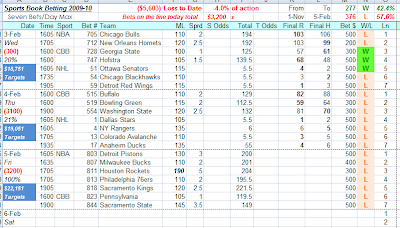


Saturday, February 6 at 8:50am

A modest rebound yesterday (+$550), but these days I'll take whatever comes!

Dogs finally came close to the 45% win rate that I expect of them, and which is demonstrably inevitable in the long run.

It is worth noting that to reach that DWR in this trial, underdogs would need to notch up at least 15 successive victories.

Given paybacks averaging +126 to date, that would be more than enough to blow away the current red number and replace it with a big fat green one not too far below the best win to date (+$6,000 on January 18).

It will happen - a return to 45%, not 15 successive wins! - but when you're stuck down a deep, dark hole, waiting for rescue, not knowing when can be almost unbearable.

A big day today: eight qualifying dogs on the NBA schedule with more likely as the odds trim closer to game time, and 11 under the NHL banner.

Here are today's numbers:-


Sunday, February 7 at 9:55am

Saturday was pretty much a wash for the 7-dog trial: three right picks covered the losses from four wrong ones but for $200.

Tough to find seven selections today, but I could hardly ignore the Super Bowl, even with the Saints at the top end of a range that I have learned from this trial is several notches too wide!

Here are the numbers...


It's a whole lot clearer than mud that this is the worst slump that the 7-dog trial has suffered since it began last November 1, and I have to concede (at least for now!) that even a partial turnaround seems unlikely...with a 5x ceiling in place, anyway.

But dogs will rebound, as they always do, and maybe when the DWR moves back into its comfort zone, it will give us the boost we need to call this limited trial a success. Finally!

An important reminder: The only person likely to make money out of this blog is you, Dear Reader. There's nothing to buy, ever, and your soul is safe (from me, at least). Test my ideas and use them or don't. It's up to you.
_